Based on official USCIS and U.S. Department of State guidance. This roadmap helps identify the next planning task. It does not determine eligibility or replace the instructions on a government notice.
The best next step in a marriage green card case is the one that resolves the next unanswered decision. Before filing, that may be identifying the correct immigration path. After filing, it may be preserving a receipt notice, attending biometrics, responding to a Request for Evidence, or preparing for an interview.
Trying to work on every stage at once usually creates more paperwork without more clarity. Instead, identify where the case is now, what the government or current instructions require, and what information is still missing.
This guide is a navigation tool. Use it to move to the detailed Dokumen resource and official instruction that matches the current stage.
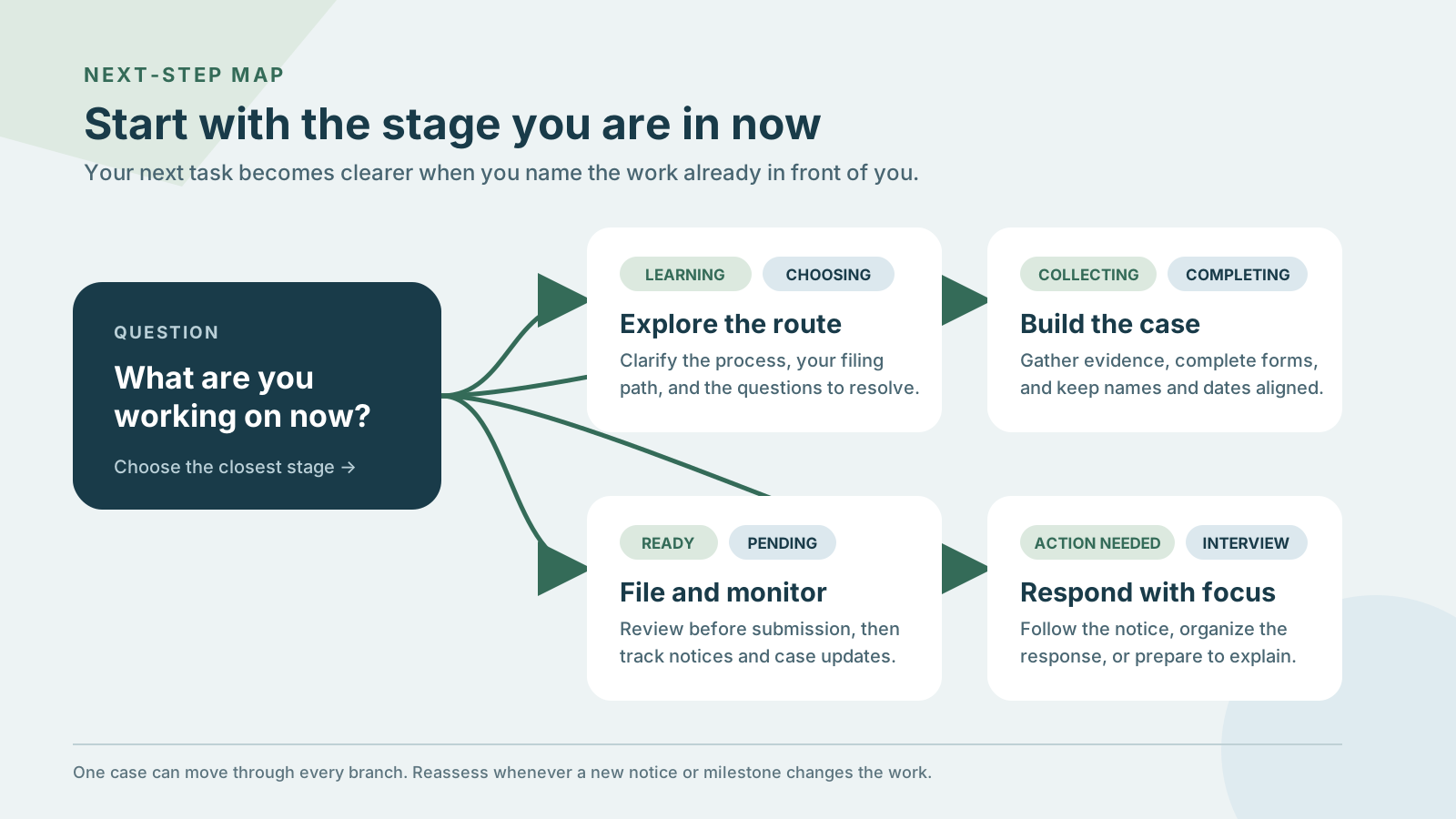
Find the current stage, resolve its next unanswered question, and then move to the resource or notice that controls that task.
What should you do next in a marriage green card case?
Start with the row that best describes the case today.
| Current stage | Next useful objective | Resource to open |
|---|---|---|
| Learning the process | Understand the relationship petition, permanent-residence path, and evidence framework | What Is a Marriage-Based Green Card? |
| Choosing where to apply | Compare adjustment eligibility with immigrant-visa processing abroad | Adjustment of Status vs. Consular Processing |
| Collecting records | Build an evidence map and document checklist | Getting Your Documents Together |
| Completing forms | Match each form to its purpose and current instructions | A Closer Look at Your Application Forms |
| Ready to file | Run a final signatures, fees, editions, addresses, and evidence review | Before You Submit Your Application |
| Case is pending | Track receipts, appointments, notices, and changes | After You File |
| Evidence requested | Read the notice literally and build a deadline-controlled response | Understanding Requests for Evidence |
| Interview scheduled | Review the filed record and follow the appointment instructions | Preparing for Your Interview |
If two rows seem to apply, begin with the earlier unresolved stage. For example, do not build a final filing package until the couple has confirmed whether Adjustment of Status is actually available.
If you are still choosing the filing path
The first question is usually not “Which PDF should we download?” It is which legal process applies to the immigrant spouse.
Adjustment of Status and Consular Processing can both lead to permanent residence, but they use different forms, agencies, interviews, and travel rules. Physical location is a starting point, not the entire eligibility analysis.
Before selecting the route, collect a short factual timeline:
- the petitioner’s U.S. citizenship or permanent-resident status;
- the immigrant spouse’s current location;
- every entry to and departure from the United States;
- current and prior immigration status;
- any prior petitions, visa applications, or removal proceedings;
- criminal or immigration-law concerns;
- prior marriages and how they ended; and
- expected travel or work needs while the case is pending.
Facts involving entry without inspection, fraud or misrepresentation, removal history, criminal matters, or uncertainty about admissibility can require individualized legal analysis. The next responsible step may be legal advice—not filing faster.
Do not choose a path solely because an online timeline says it is quicker. The route must first be legally available for the applicant’s circumstances.
If you are preparing the application
Once the path is clear, turn the case into four connected workstreams.
1. Forms
List every form required for the chosen path and explain its purpose in one sentence. This prevents the common mistake of treating Form I-130 approval as approval of permanent residence or assuming that an employment or travel request is included automatically.
Use the current form page to verify the accepted edition, instructions, filing method, filing address, and applicable fee immediately before submission.
2. Eligibility facts
Create a factual timeline for names, addresses, employment, immigration history, marriages, children, and travel. Complete forms from the same verified timeline so repeated answers remain consistent.
3. Supporting evidence
Build an evidence map that connects each record to the fact or requirement it supports. Separate:
- petitioner status;
- legal marriage and prior-marriage termination;
- bona fide relationship evidence;
- identity and civil records;
- immigration history;
- financial sponsorship; and
- process-specific evidence.
4. Quality control
Before filing, confirm signatures, dates, page completeness, translations, fees, and filing location. Preserve an exact copy of the final submission and delivery information.
Finishing one workstream does not compensate for a missing requirement in another. A polished evidence index cannot cure an unsigned form, and a completed form cannot replace required initial evidence.
If the application has already been filed
After filing, the priority changes from building a package to tracking the record and responding to official communication.
Create a case log containing:
- each form filed;
- filing and delivery dates;
- receipt numbers and notice dates;
- online-account access information stored securely;
- biometrics, interview, or medical appointments;
- address changes;
- evidence requests and response deadlines;
- copies of every response; and
- decisions or document-delivery updates.
USCIS receipt numbers can be used with Case Status Online. The receipt notice also identifies the form received and may contain instructions relevant to the case.
Continue preserving new relationship evidence while the case is pending, particularly if an interview may occur later. Do not create documents for immigration purposes; retain ordinary records that accurately reflect the ongoing marriage.
If the couple moves
Changing an address with the U.S. Postal Service does not necessarily update the address with USCIS. Follow USCIS’s current change-of-address instructions for each person and pending case. Sponsors may also have separate Form I-865 obligations under the Affidavit of Support rules.
If USCIS or a consulate asks for action
The notice itself controls the next step. Read it from beginning to end before collecting documents.
Biometrics notice
Follow the appointment notice for the date, location, identification, and rescheduling method. Biometrics collection supports identity and security checks; it is not an interview on the merits of the marriage.
Request for Evidence
Identify:
- the exact form and case involved;
- what USCIS says is missing or insufficient;
- the response deadline and permitted delivery method;
- whether the notice expects one complete response; and
- the evidence or explanation that answers each numbered issue.
Do not respond with an unrelated document dump. Build the response around the wording and order of the notice.
Interview notice
Review the entire filed record, update relevant evidence, gather the items listed in the notice, and verify the appointment logistics. For consular processing, also follow the assigned embassy or consulate’s instructions, including medical-examination and original-document requirements.
Decision or document-production notice
Read what was decided, which benefit or form the decision covers, and whether any follow-up task remains. An I-130 approval, an I-485 approval, and immigrant-visa issuance are different events with different consequences.
A simple weekly case routine
Most pending cases do not require daily activity. A short, repeatable routine can reduce missed tasks:
- review new physical mail and online-account notices;
- save each notice using its date and form number;
- update the case log;
- check upcoming deadlines and appointments;
- add relevant new evidence to the working file; and
- write down questions rather than making assumptions from an unexplained status message.
Use current government processing information for the form and office handling the case. Avoid comparing one case directly with a friend’s or a social-media timeline.
Next-step questions
Should the couple wait for every document before starting?
No. Start with the process and evidence map, then mark records as ready, requested, needs translation, or needs clarification. Do not submit until the required filing elements are complete.
What if the online case status has not changed?
Online status is only one source of information. Preserve the receipt notice, monitor official mail and the online account, and use USCIS’s current processing and inquiry tools when the case becomes eligible for an inquiry.
Can additional evidence be mailed after filing?
Do not send unsolicited material unless the agency’s instructions provide a method and reason to do so. Save relevant updates for an authorized upload, RFE response, or interview as appropriate.
What if a deadline is close and a document is unavailable?
Read the notice and controlling instructions immediately. Because missing a deadline can have serious consequences, seek qualified legal help promptly when the required response cannot be completed or the notice is unclear.
When should a lawyer review the case?
Consider individualized legal advice when eligibility is uncertain or the record includes prior denials, removal proceedings, unlawful presence, entry issues, fraud or misrepresentation concerns, criminal history, or other facts requiring legal judgment.
The bottom line
The marriage green card process becomes easier to manage when each stage has one defined objective:
- Choose the legally available path.
- Build accurate forms and supporting evidence.
- Review the complete package before filing.
- Track the case and follow official notices after filing.
- Escalate legal questions instead of guessing.
Do the next required task well, preserve the record, and then move to the following stage.
Not sure which stage applies?
Start with the marriage green card overview, or answer a short set of questions to identify the likely filing path and the topics to review next.
Official sources
- USCIS — Case Status Online
- USCIS — How to Change Your Address
- USCIS — Processing Times
- USCIS — Contact Center
- U.S. Department of State — Immigrant Visa Process
- U.S. Department of State — Interview Preparation
Last reviewed: October 12, 2026
Legal information only. Dokumen is not a law firm and does not provide legal advice. Immigration rules depend on individual circumstances. When a case involves legal uncertainty or significant immigration history, consider speaking with a qualified immigration attorney.