Based on official USCIS and U.S. Department of State guidance. Review the current instructions for every form and the submission rules for the agency handling the case immediately before filing.
Before submitting a marriage green card case, confirm three things in order: the filing path is legally available, every answer is accurate and supported, and the package follows the current agency instructions. Do not begin with page tabs or a cover letter while a question about eligibility remains unresolved.
This checklist can help with a Form I-130 petition, an Adjustment of Status package, or National Visa Center document submission. It is not a substitute for the checklist and instructions issued for the particular form, online account, embassy, or consulate.
If the difference between the two permanent-residence paths is unclear, review Adjustment of Status vs. Consular Processing before using this checklist.
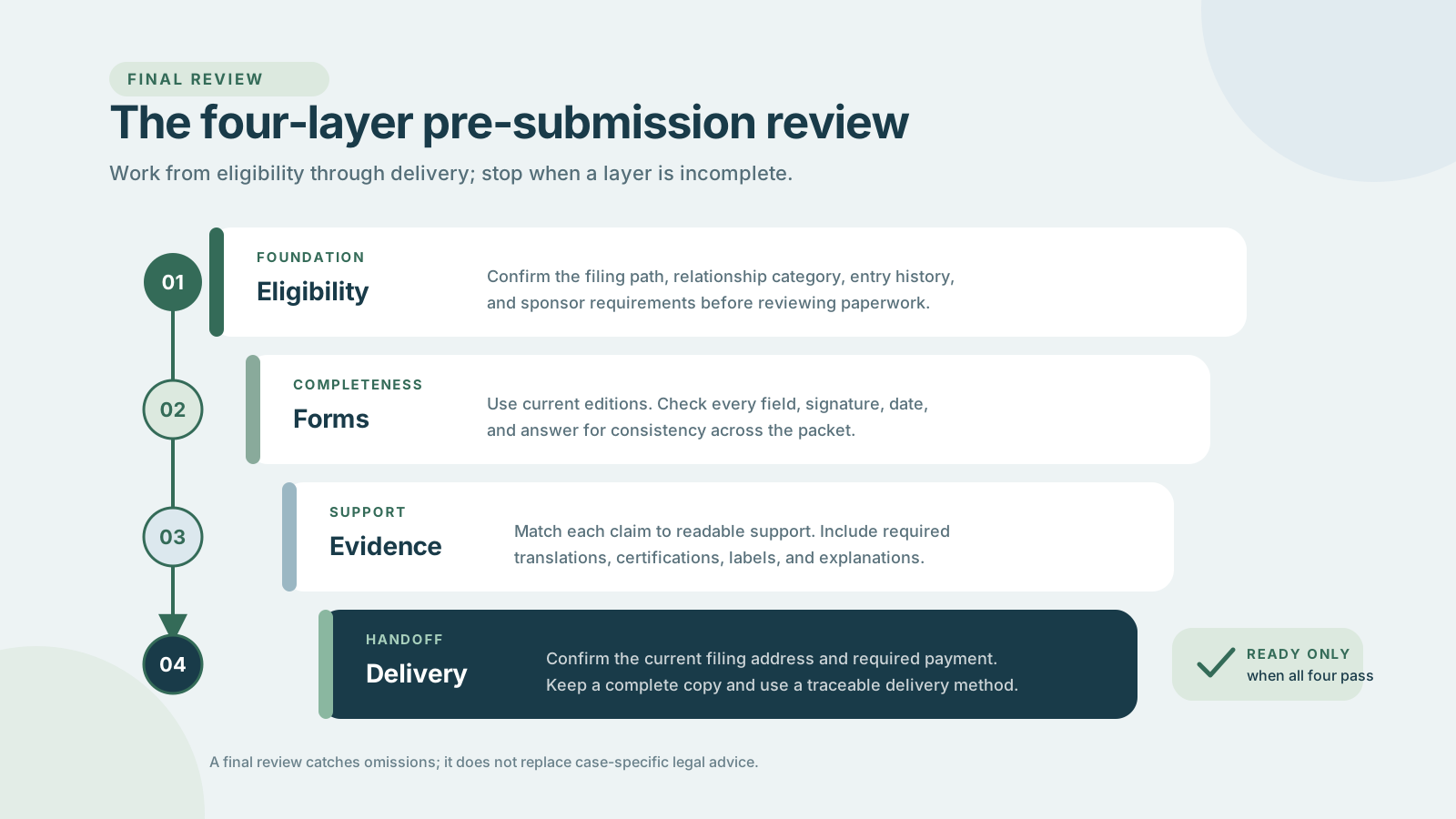
Review from the inside out: confirm the path first, then verify the forms, supporting evidence, and current delivery instructions.
What should you check before submitting?
A useful final review has four layers:
- Eligibility: Is the petitioner allowed to file, and is the immigrant spouse eligible for the process being used?
- Forms: Are the correct current forms complete, signed, and internally consistent?
- Evidence: Does the submission contain the required initial evidence, complete translations, and case-specific explanations?
- Delivery: Are the current fee, filing location, submission method, and tracking or confirmation plan correct?
Review the final version, because one changed fact may require updates in several forms and exhibits.
For paper filing, confirm every edition date. For online or NVC filing, review the generated submission and follow the instructions in the account.
Confirm the filing path and eligibility
The correct paperwork follows from the legal path.
Relationship petition
Form I-130 asks USCIS to recognize the qualifying spousal relationship. Approval does not by itself grant a green card, lawful status, work authorization, or permission to travel.
Adjustment of Status
An eligible applicant physically present in the United States generally uses Form I-485. Physical presence and marriage alone are not enough. Manner of entry, visa availability, status history, adjustment bars, admissibility, and prior immigration events can matter.
Consular Processing
An applicant pursuing an immigrant visa abroad generally completes Form DS-260 after USCIS petition approval and NVC case creation. NVC processing includes financial sponsorship and civil documents before interview scheduling.
Pause the routine checklist and consider qualified legal advice if the case includes entry without inspection, removal proceedings or an order of removal, unlawful presence and planned departure, arrests or convictions, inaccurate prior applications, possible fraud or misrepresentation, a false claim to U.S. citizenship, use of another identity, or uncertainty about admissibility. These issues can change the appropriate process and the required forms.
Final marriage green card submission checklist
Use this table as a second review after completing the official form-specific checklist.
| Review area | Final questions |
|---|---|
| Forms and edition dates | Is every required form included? Does each paper form use an edition USCIS currently accepts, with all pages from the same edition? |
| Names and identity | Do legal names, other names used, dates and places of birth, identifying numbers, and passport details match the records or have truthful explanations? |
| Marriage history | Is the current marriage documented, and is the legal termination of every prior marriage addressed for the people required by the instructions? |
| Address and employment history | Are time periods complete and consistent across forms, without accidental gaps or conflicting current information? |
| Immigration history | Are entries, departures, status, prior petitions, applications, denials, proceedings, and required violations answered fully? |
| Yes-or-no eligibility questions | Was every question read carefully with its definitions, and are explanations and records attached where required? |
| Relationship evidence | Does the evidence show the bona fide marriage over time, with labels or context that make the records understandable? |
| Financial sponsorship | Are the correct sponsor forms, income or asset records, household-size information, and any joint-sponsor or household-member documents included? |
| Civil and medical records | Are the required birth, marriage, divorce, identity, police, court, and medical items included or prepared under the rules for the filing path? |
| Translations | Does every required foreign-language document have a complete translation and translator certification that meets the applicable agency rule? |
| Signatures | Has every petitioner, applicant, sponsor, household member, preparer, interpreter, and representative signed where required? |
| Fee and submission details | Were the current fee, payment method, filing address or online route, and delivery instructions verified on the official site? |
Do not submit false information to make a discrepancy disappear. If two accurate records differ, explain the difference and provide reliable supporting evidence where appropriate.
How should a paper packet be organized?
The official form instructions control, but a simple organization system can make the filing easier to review.
- Place the correct payment or payment authorization as instructed. Do not assume fees that were correct when drafting are still correct.
- Group each form with its required evidence. Clearly identify which records support which request, especially when multiple forms are mailed together.
- Submit legible copies rather than irreplaceable originals unless originals are specifically required. USCIS may request originals later.
- Place complete certified translations with the corresponding foreign-language documents. Keep both the source document and translation easy to locate.
- Make a complete final copy before sealing the package. Include signed pages and the exact exhibits being sent.
- Verify the address for the selected delivery service and use tracking. USCIS may list different addresses for postal and courier deliveries.
For NVC processing, submit documents through the method directed for the case. Department of State guidance warns applicants not to send an original passport or original civil documents to NVC; the applicant generally brings required originals or certified copies to the immigrant-visa interview.
Which mistakes can delay or derail a filing?
Using an outdated edition or incomplete form
USCIS publishes accepted edition information on each form page. Missing pages, mixed editions, or an unaccepted edition can result in rejection.
Missing a required signature
Unsigned forms can be rejected. Review every signature block after printing or generating the final version. Do not assume that typing a name, signing one form, or attaching a cover letter signs the entire package.
Sending the wrong fee or using the wrong payment method
Fees and payment policies can change and may differ by form, filing method, and applicant category. Use the current USCIS Fee Schedule or fee calculator and the latest form instructions instead of an old checklist.
Mailing to an old or mismatched address
The correct lockbox can depend on the form combination, eligibility category, residence, and carrier. Verify the address on the official page immediately before shipping.
Leaving inconsistencies unexplained
A typo in a date is different from an undisclosed arrest or immigration event, but both deserve accurate correction. Compare all forms against the same records and prepare explanations for material differences.
Before-submission FAQs
Should original civil documents be mailed to USCIS?
Generally submit legible copies unless the form instructions request an original. USCIS can later ask to inspect an original. Consular applicants follow different NVC and interview rules and should bring required originals or certified copies to the interview.
Can the couple submit forms downloaded months earlier?
Only after confirming that USCIS still accepts that edition. Recheck the official form page and instructions; do not rely on the date the PDF was downloaded.
Can missing evidence be sent later?
Do not plan around a future request for evidence. Submit all required initial evidence under the current instructions. USCIS may reject or deny some deficient filings, and an RFE is not guaranteed.
Can a mistake be corrected after filing?
Some errors can be updated or corrected, but the method and consequences depend on the fact and procedural stage. Preserve the filed copy and address significant errors promptly. Seek legal advice when the issue could affect eligibility, admissibility, or credibility.
The bottom line
The strongest submission is not necessarily the thickest. It is the one that uses the correct legal path, answers every question truthfully, provides the required evidence in a clear structure, and follows the current submission rules.
Before filing, complete one last independent review:
- correct path and eligibility;
- current editions and instructions;
- consistent facts and complete explanations;
- required signatures, evidence, and translations;
- current fees, payment method, and destination; and
- a complete retained copy and delivery record.
Take the next step
Review A Closer Look at Marriage Green Card Application Forms for the role of each major form. For a broader process overview, read What Is a Marriage-Based Green Card?.
Use the Dokumen eligibility quiz to organize the facts that determine the likely path before relying on a submission checklist.
Official sources
- USCIS — Tips for Filing Forms by Mail
- USCIS — Filing Guidance
- USCIS — Forms Updates
- USCIS — Fee Schedule
- USCIS — Form I-130, Petition for Alien Relative
- USCIS — Form I-485, Application to Register Permanent Residence or Adjust Status
- U.S. Department of State — Submitting Documents to the National Visa Center
- U.S. Department of State — Collect Civil Documents
Last reviewed: October 12, 2026
Legal information only. Dokumen is not a law firm and does not provide legal advice. Immigration rules and form requirements depend on individual circumstances and can change. Review the current instructions for every form and consider speaking with a qualified immigration attorney when a case involves legal uncertainty, prior immigration history, arrests, or possible inadmissibility.