Based on official U.S. Citizenship and Immigration Services (USCIS) and U.S. Department of State guidance. This roadmap explains the general stages of a marriage-based case. The exact forms, evidence, and sequence depend on the couple’s filing path and circumstances.
The marriage green card journey is the process through which an eligible spouse seeks U.S. lawful permanent residence based on a qualifying marriage to a U.S. citizen or lawful permanent resident.
Most cases move through the same broad stages: confirm the relationship, identify the correct path, prepare the filing, respond to notices, complete any required interview, and receive a decision. The details depend heavily on whether the immigrant spouse uses Adjustment of Status in the United States or Consular Processing abroad.
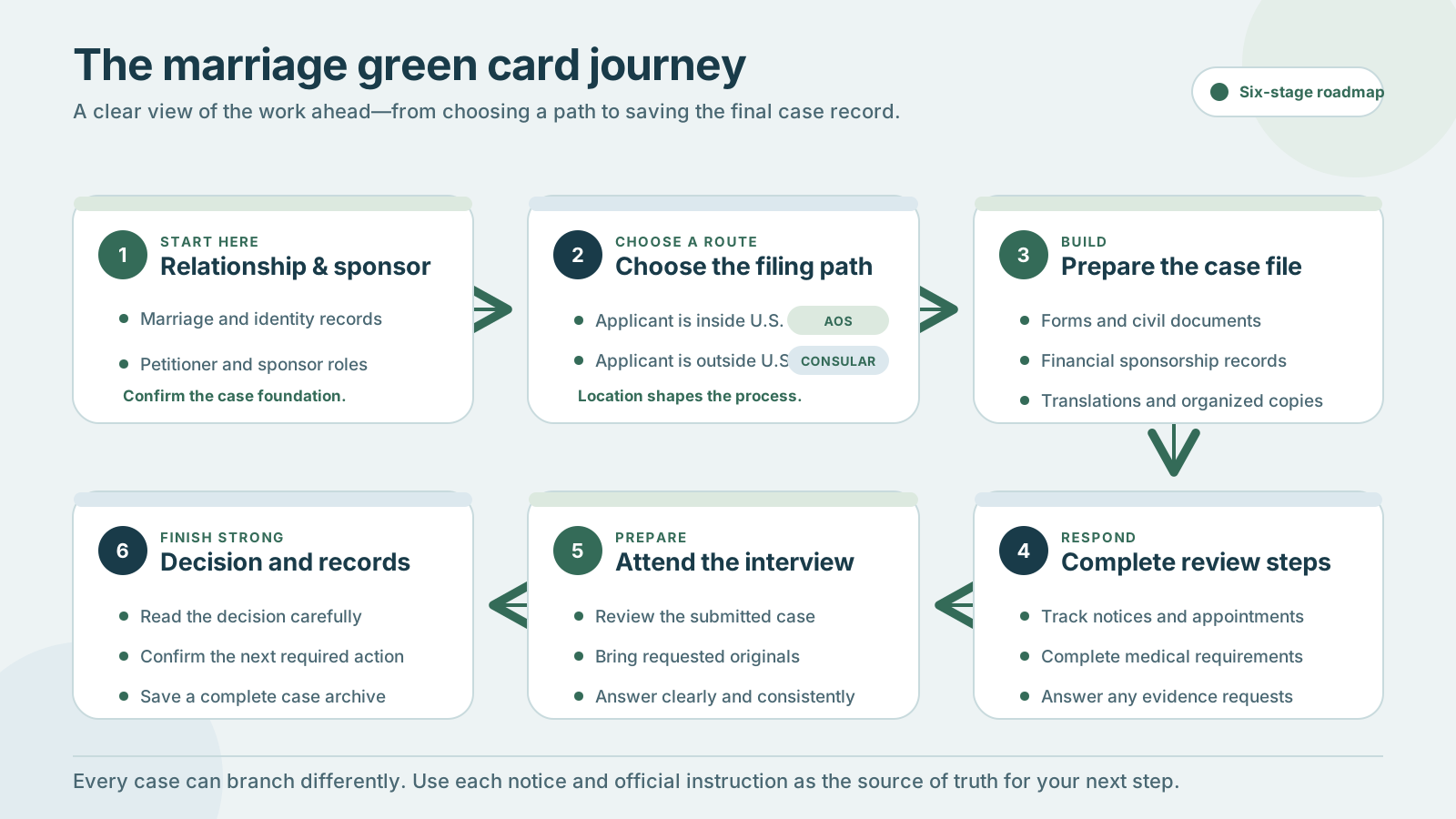
Use the roadmap to locate the case’s current stage before deciding which form, document, or notice needs attention next.
What does the marriage green card journey look like?
| Stage | Main question | Typical result |
|---|---|---|
| 1. Relationship and sponsor | Is there a qualifying marriage, and can the petitioning spouse file for the immigrant spouse? | A clear filing basis and relationship-evidence plan |
| 2. Filing path | Will the immigrant spouse use Adjustment of Status or Consular Processing? | The correct agencies, applications, and sequence |
| 3. Preparation and filing | Do the forms and supporting records establish the required facts? | A complete, internally consistent submission |
| 4. Government review | Has USCIS or the Department of State requested an action or more information? | Notices, appointments, case updates, or an evidence response |
| 5. Interview and decision | Has the applicant established eligibility through the selected process? | Approval, a request for further action, or another decision |
| 6. After approval | Does conditional residence or another post-approval task apply? | Permanent-resident documentation and any future filing plan |
The first step is not downloading every form. It is confirming the facts that determine how the case should be built.
Stage 1: Confirm the relationship and the sponsor
In a typical case, the U.S. citizen or lawful permanent resident spouse is the petitioner, and the immigrant spouse is the beneficiary or applicant. The couple generally documents:
- the petitioner’s U.S. citizenship or lawful permanent resident status;
- a legally valid marriage;
- the legal termination of any prior marriages, where applicable; and
- a bona fide marital relationship entered into in good faith rather than solely for an immigration benefit.
Form I-130, Petition for Alien Relative, generally asks USCIS to recognize the qualifying relationship, while Form I-130A ordinarily provides information about the beneficiary spouse. I-130 approval does not grant permanent residence; the immigrant spouse must still complete the appropriate process and establish eligibility.
Before moving forward, reconcile foundational facts such as legal names, prior names, dates of birth, marriage dates, prior-marriage dates, residences, employment history, and immigration history. A small discrepancy may have an innocent explanation, but unexplained inconsistencies can create avoidable questions later.
Stage 2: Choose the correct filing path
The two main routes are Adjustment of Status and Consular Processing.
Adjustment of Status is generally used by an eligible applicant who is physically present in the United States and files Form I-485 with USCIS. Consular Processing generally involves an approved family petition, National Visa Center processing, Form DS-260, and an immigrant-visa interview at a U.S. embassy or consulate abroad.
Location is the starting point, not the complete eligibility test. The path can also depend on:
- how the immigrant spouse entered the United States;
- present and past immigration status;
- whether an immigrant visa is available in the applicable category;
- possible adjustment bars or grounds of inadmissibility;
- prior immigration applications, removal proceedings, or departure history; and
- whether travel during the process could create a separate consequence.
Do not select a route only because it appears faster or more convenient. The proper route is the one the applicant is legally eligible to use. For a closer comparison, read Adjustment of Status vs. Consular Processing.
Stage 3: Build and submit the case
Once the path is clear, create a checklist from the current government instructions. A marriage-based submission may include:
- Identity and civil records — passports, birth records, marriage certificates, prior-marriage termination records, and any required translations.
- Petitioner-status evidence — records establishing U.S. citizenship or permanent residence.
- Relationship evidence — records that accurately demonstrate the couple’s shared residence, finances, responsibilities, family life, travel, communication, or other parts of an ongoing marriage.
- Immigration records — arrival, status, prior filing, or court records relevant to the applicant and the selected path.
- Financial sponsorship — the applicable Affidavit of Support and supporting financial documentation.
- Path-specific records — evidence required by Form I-485 and its instructions or by NVC and the assigned embassy or consulate.
Use the current form editions, report facts consistently, and keep an exact filed copy with proof of submission.
Getting Your Documents Together explains how to turn those requirements into an organized working file.
Stage 4: Manage the case after filing
Filing changes the work; it does not end it.
USCIS may issue receipts, biometrics instructions, interview notices, transfer notices, or a Request for Evidence. In a consular case, NVC and the assigned post may provide document instructions, case messages, appointment information, or correction requests. Log the notice, case number, date received, deadline, required action, owner, and completion evidence.
Read the complete notice, including the final pages and submission instructions. Save both the envelope and the notice if mailing dates or delivery become relevant. If USCIS requests evidence, respond according to the deadline, address, and method stated in that specific notice. Understanding a Request for Evidence provides a structured response workflow.
Keep addresses current with the relevant agencies and preserve meaningful new records that may be useful later.
Stage 5: Prepare for the interview and decision
Not every case follows the same interview procedure. If an interview is scheduled, use the appointment notice and agency instructions—not a generic online list—as the controlling checklist.
Preparation should include:
- reviewing the exact copies of all submitted forms;
- identifying changes since filing, such as a new address, job, child, trip, or corrected fact;
- gathering the originals or certified copies the notice requires;
- organizing updated relationship evidence without manufacturing or exaggerating a record;
- planning identification, interpreter, and security requirements; and
- reviewing material inconsistencies or legal concerns before the appointment.
At an Adjustment of Status interview, USCIS may review both the relationship and the applicant’s eligibility for permanent residence. At a consular interview, the applicant must follow the assigned post’s instructions and bring the required originals or certified copies of civil documents submitted through NVC.
A case may be approved, denied, held for review, or followed by another instruction. Wait for the formal decision or visa issuance before making irreversible plans.
After approval: understand what comes next
For Adjustment of Status, residence begins when USCIS approves Form I-485. In a consular case, it generally begins upon admission with the immigrant visa. If the marriage is less than two years old when residence is obtained, conditional residence generally applies and Form I-751 is ordinarily filed later under its rules. Review the card for accuracy, store the approval record, and calendar future requirements.
How to stay organized across the entire journey
Maintain one master timeline, separate drafts from final forms, index each requirement to its evidence, record every submission, and calendar every notice. Store sensitive records securely. Organization cannot create eligibility, but it makes accurate facts easier to verify and prevents the case from being rebuilt from memory.
Marriage green card journey FAQs
Does every marriage green card case begin with Form I-130?
Form I-130 is the usual relationship petition for a spouse of a U.S. citizen or lawful permanent resident, although specialized circumstances can follow different rules. Approval of the petition alone does not grant permanent residence.
Can the couple submit the I-130 and I-485 together?
Concurrent filing may be available when the applicant qualifies and an immigrant visa is immediately available, as is generally the case for immediate relatives of U.S. citizens. It is not available in every marriage case.
Does a pending marriage case authorize work or travel?
No. A pending I-130 does not itself provide employment or travel authorization, and filing Form I-485 alone does not authorize either activity. Separate status or approved documentation may be required.
How long will the entire journey take?
There is no single reliable timeline for every couple. Petition processing, visa availability, NVC review, local office or post capacity, evidence requests, and individual facts can all affect timing. Use the current official tools for each stage.
The bottom line
A marriage green card case is easier to understand when it is divided into five core tasks:
- establish the qualifying relationship;
- choose the legally available filing path;
- submit accurate forms and supporting evidence;
- manage notices, appointments, and updates; and
- prepare for the interview, decision, and any post-approval requirement.
The strongest plan is not the one with the most paper. It is the one in which the path is correct, the answers are consistent, the evidence is relevant, and every government instruction is handled on time.
Plan your next step
Start with What Is a Marriage-Based Green Card?, compare the filing paths, and build a checklist for the route that applies. Dokumen can help organize the starting facts.
Official sources
- USCIS — Form I-130, Petition for Alien Relative
- USCIS — Form I-485, Application to Register Permanent Residence or Adjust Status
- USCIS — Form I-864, Affidavit of Support
- USCIS — Form I-751, Petition to Remove Conditions on Residence
- USCIS — Case Status Online
- U.S. Department of State — The Immigrant Visa Process
- U.S. Department of State — Immigrant Visa for a Spouse of a U.S. Citizen
Last reviewed: October 12, 2026
Legal information only. Dokumen is not a law firm and does not provide legal advice. Immigration rules depend on individual circumstances. When eligibility, deadlines, inadmissibility, or prior immigration history is uncertain, consider speaking with a qualified immigration attorney.