Based on official U.S. Citizenship and Immigration Services (USCIS) and U.S. Department of State guidance. This guide provides an organization method, not a universal filing checklist. Always follow the current instructions for the forms, agency, and U.S. embassy or consulate involved in the specific case.
Getting your marriage green card documents together means organizing the records that establish the petitioner’s status, legal marriage, good-faith relationship, applicant’s identity and immigration history, financial sponsorship, and path-specific eligibility. Start with official requirements, index each item by the fact it proves, and preserve the final submission.
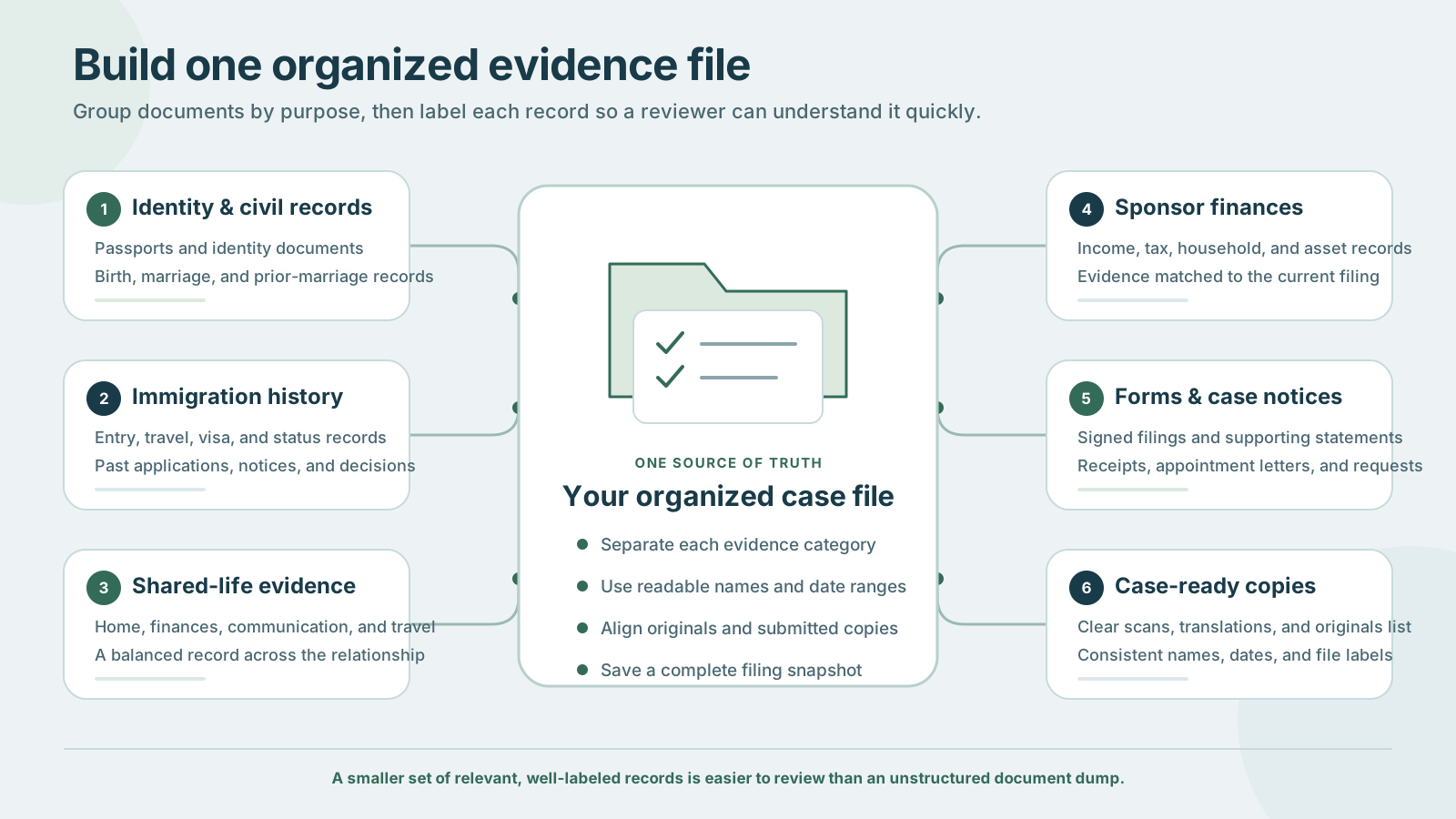
A useful file groups records by purpose, then connects each item to the form question or requirement it supports.
Which documents belong in a marriage green card file?
The required set depends on the case, but most couples work with several document groups.
| Document group | What it may establish | Common examples |
|---|---|---|
| Petitioner status | The petitioner is a U.S. citizen or lawful permanent resident | Passport, birth or naturalization record, or permanent resident card evidence, as permitted by the instructions |
| Legal relationship | A valid current marriage and termination of prior marriages | Marriage certificate, final divorce decree, annulment record, or death certificate |
| Bona fide marriage | The spouses intended to build a shared life | Joint residence, finances, insurance, taxes, travel, correspondence, photographs, children, or affidavits where useful |
| Identity and civil records | The applicant’s identity and civil history | Passport biographic page, birth certificate, name-change record, photographs, and path-specific civil documents |
| Immigration history | Entry, status, prior applications, or proceedings | Admission and travel records, visas, prior notices, employment authorization records, or court documents where applicable |
| Financial sponsorship | The sponsor meets the applicable Affidavit of Support requirements | Form I-864 and the financial records required by its instructions |
| Path-specific evidence | Eligibility for Adjustment of Status or immigrant-visa processing | Form I-485 supporting evidence or NVC and post-specific documents |
A document belongs because it satisfies an instruction or establishes a relevant fact—not because another applicant submitted it.
Start with the correct government instructions
Before downloading records, confirm the filing path. An Adjustment of Status package filed with USCIS differs from an immigrant-visa case processed through the National Visa Center and a U.S. embassy or consulate.
Create the checklist from:
- the current edition of each form and its instructions;
- the USCIS filing page or NVC instructions for that stage;
- any checklist generated by the agency for the particular filing;
- the Department of State Reciprocity and Civil Documents by Country information for consular cases; and
- any appointment notice or post-specific interview instructions received later.
Check again before submission because editions, filing locations, and procedures can change. Do not combine requirements from different routes. A consular applicant may upload civil-document copies and later bring originals or certified copies to the interview, while a USCIS filing follows its applicable form instructions.
If the path itself is unclear, review Adjustment of Status vs. Consular Processing before building the checklist.
Build a master document index
A master index turns an unstructured folder into a working case file. Use one row for each requirement, then connect it to the supporting record.
| Requirement | Planned evidence | Owner | Status | Final filename or tab |
|---|---|---|---|---|
| Petitioner’s status | U.S. passport biographic page | Petitioner | Ready | A-01_Petitioner-Passport.pdf |
| Legal marriage | Certified marriage record | Both | Ready | B-01_Marriage-Certificate.pdf |
| Shared residence | Current joint lease and selected utility records | Both | Updating | C-01_Joint-Residence.pdf |
| Financial sponsorship | Current I-864 evidence under the instructions | Petitioner | Review needed | D-01_Sponsor-Financials.pdf |
Distinguish between:
- required evidence, which the instructions say must be provided;
- supporting evidence, which helps establish a relevant fact; and
- working records, which help prepare the case but are not intended for submission.
Mark an item complete only after confirming it is readable, complete, properly issued, and consistent with the forms.
Organize identity, civil, and immigration records
Civil records should match the identity information used in the forms. If a name, date, or place differs across records, identify the reason and any supporting name-change or correction document before filing.
For each spouse, securely organize identification, civil records, name changes, prior-marriage termination records, immigration notices, travel and status records, and any court or law-enforcement records required by the instructions.
For consular processing, consult the Department of State’s country-specific civil-document information and NVC upload rules. The applicant generally brings required originals or certified copies to the interview. Do not mail irreplaceable originals unless an instruction or notice requires them.
Organize relationship and financial evidence
For a spousal I-130, USCIS looks for evidence of a bona fide marriage—one entered into in good faith, not solely to obtain an immigration benefit.
Useful evidence may cover the couple’s home, finances, insurance, benefits, taxes, children, responsibilities, travel, photographs, correspondence, and detailed third-party affidavits where useful.
There is no universal number of photographs, bank statements, or affidavits that proves a marriage. A focused set covering different time periods and aspects of shared life is usually easier to understand than repetitive pages that add no new information.
Keep Form I-864 evidence in its own section. Joint relationship evidence does not automatically satisfy financial-sponsorship requirements.
Never create, backdate, or alter records. If genuine joint evidence is limited by distance, work, military service, finances, or the age of the marriage, organize what exists and explain material context accurately.
Handle translations, copies, and digital files correctly
For USCIS, a foreign-language document generally must be accompanied by a full English translation and the translator’s certification that the translation is complete and accurate and that the translator is competent to translate from the foreign language into English. Follow the language and certification rules in the specific form instructions.
Department of State translation requirements depend on the immigrant-visa instructions and the language of the document. Review NVC guidance and the instructions for the embassy or consulate handling the case.
For every digital file:
- Scan every required page, including the reverse side if it contains information.
- Check names, dates, stamps, seals, signatures, and marginal notes at readable magnification.
- Keep the original document and its translation together in the intended order.
- Use consistent filenames that identify the date, person, and record type.
- Preserve an unedited copy and follow current file-size, format, and upload rules.
Do not crop out content or digitally change a government record. If it contains an apparent error, use the issuing authority’s correction process. Store sensitive identity, financial, medical, and relationship records securely with limited access.
Run a submission-ready review
Before filing, compare the final evidence against the forms—not merely against the working checklist.
Check that current forms are complete and signed; every required item and translation is present; names, dates, addresses, prior marriages, and immigration events are consistent or explained; and the relationship timeline matches the evidence. Then confirm the filing destination, required order, technical rules, payment, and delivery method.
Freeze the final copy after submission. If the case is later transferred, reviewed at an interview, or followed by a Request for Evidence, everyone should be working from the same filed record.
Marriage green card document FAQs
Should every available relationship document be submitted?
No. Evidence should be relevant, accurate, and reasonably organized. Repetitive records can make the important facts harder to find without making the case stronger.
Are original documents required with a USCIS filing?
Follow the applicable form instructions and any notice. USCIS commonly accepts legible copies for many filing-stage records but may request an original later. Do not assume one copy rule applies to every item.
What if a required civil document is unavailable?
Use the agency’s country-specific or form-specific guidance. The proper response may depend on whether the issuing authority considers the document unavailable and whether secondary evidence or a written explanation is permitted.
Should evidence be updated after filing?
Continue preserving meaningful new records. Updated relationship, address, employment, or financial information may be relevant to an interview or later agency request, but do not send unsolicited material unless the agency’s procedure permits it and there is a clear reason to do so.
The bottom line
A useful marriage green card document file has four qualities:
- it follows the correct path and current instructions;
- it connects every record to a fact or requirement;
- it preserves readable, accurate, and consistent documents; and
- it leaves a complete trail of what was submitted and what happened next.
Start with the official checklist, not a random pile of evidence. Build the index, fill the genuine gaps, review the forms against the documents, and keep the final filed version unchanged.
Put the documents into a case plan
Understand the marriage green card journey before collecting documents. If USCIS later asks for more, use Understanding a Request for Evidence. Dokumen can help turn the facts and document list into a clearer plan.
Official sources
- USCIS — Form I-130, Petition for Alien Relative
- USCIS — Instructions for Form I-130
- USCIS — Form I-485, Application to Register Permanent Residence or Adjust Status
- USCIS — Form I-864, Affidavit of Support
- U.S. Department of State — Collect Civil Documents
- U.S. Department of State — Submitting Documents to the NVC
- U.S. Department of State — Interview Preparation
Last reviewed: October 12, 2026
Legal information only. Dokumen is not a law firm and does not provide legal advice. Immigration rules depend on individual circumstances. When eligibility, deadlines, inadmissibility, or prior immigration history is uncertain, consider speaking with a qualified immigration attorney.