Based on official USCIS and U.S. Department of State guidance. The post-filing sequence depends on the forms, filing path, government office, and individual case. The instructions on each notice control the required action.
After a marriage green card filing, the case moves from preparation into government intake and review. The next event may be a receipt notice, online-account update, biometrics appointment, document request, interview, transfer, or decision.
There is no single event sequence that applies to every couple. An Adjustment of Status case is primarily handled by USCIS. A Consular Processing case generally moves from USCIS petition adjudication to the National Visa Center and then to a U.S. embassy or consulate.
The safest way to manage the pending stage is to preserve the complete filing record, track each form separately, and treat every government notice as a new set of instructions.
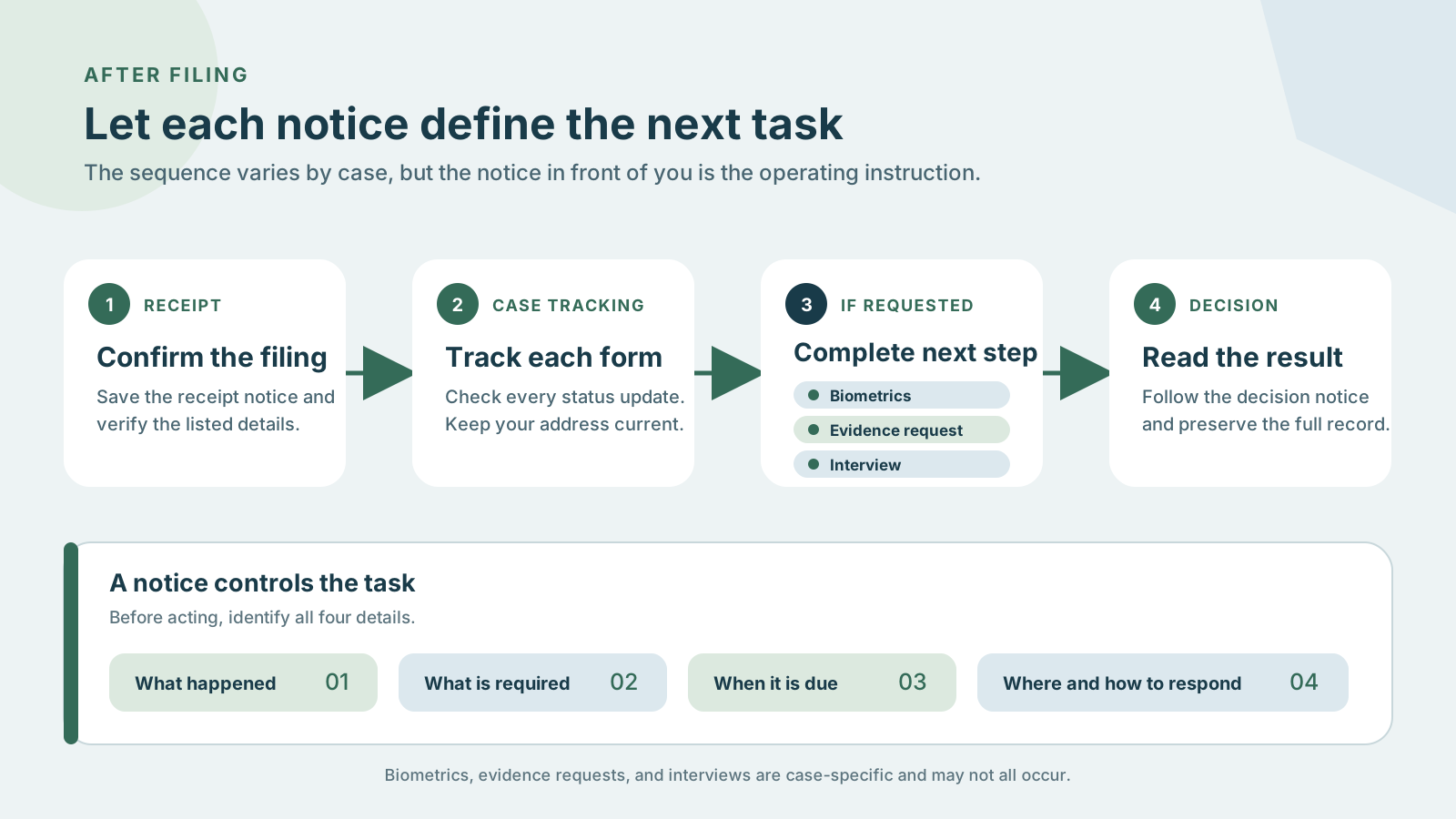
The exact sequence varies, but every case benefits from form-by-form tracking and a separate checklist for each official notice.
What happens after filing a marriage green card case?
The two principal paths have different post-filing milestones.
| Stage | Adjustment of Status | Consular Processing |
|---|---|---|
| Initial intake | USCIS accepts and receipts the filed forms | USCIS accepts and receipts Form I-130 |
| Pre-decision processing | Possible biometrics, background checks, evidence requests, transfer, and interview | USCIS adjudicates I-130; after approval, the eligible case generally transfers to NVC |
| Document stage | USCIS reviews Form I-485 and supporting evidence | NVC collects fees, Form DS-260, financial evidence, and civil documents |
| Interview | USCIS may schedule an interview at a field office | The embassy or consulate schedules an immigrant-visa interview after NVC processing |
| Result | Approval of Form I-485 grants permanent residence | Visa issuance is followed by admission to the United States as a permanent resident |
One filing package can produce several receipt numbers because USCIS tracks forms separately. A petition, permanent-residence application, employment-authorization request, and travel-document request can each move on a different schedule and receive a different decision.
Receipt notices and case tracking
USCIS generally issues Form I-797, Notice of Action, to acknowledge receipt or communicate other case actions. When the first notices arrive:
- Compare the applicant and petitioner names with the filing copy.
- Confirm the form number and receipt date.
- Record the receipt number for each form.
- Save the original notice and a digital copy.
- Follow instructions for linking a paper-filed case to an online account, if provided.
- Check that the mailing address is correct.
The receipt number can be used with USCIS Case Status Online. A status message can be useful, but it does not replace a mailed or online notice containing an appointment, request, deadline, or decision.
Track forms separately
If Forms I-130, I-485, I-765, and I-131 were filed together, create a separate row for each form. Approval of one does not automatically mean the others were approved.
For example, approval of Form I-130 generally establishes the qualifying family relationship. The immigrant spouse must still complete the applicable permanent-residence process.
Keep delivery evidence
For a mailed filing, preserve the carrier, tracking number, delivery confirmation, and a complete copy of the package. For online filing, preserve the submission confirmation and final uploaded documents.
These records help distinguish what was prepared from what was actually submitted.
Biometrics, medical examinations, and background checks
USCIS may schedule an applicant for a biometric services appointment to collect fingerprints, a photograph, and a signature for identity and security checks. Follow the appointment notice for what to bring, where to appear, and how to request rescheduling if necessary.
Biometrics is not the marriage interview and does not mean the application has been approved. It is one part of case processing.
Medical examination in an adjustment case
Form I-485 applicants generally must satisfy the immigration medical-examination requirement using the form and submission timing specified in current USCIS instructions. Medical-form rules can change, so verify the current Form I-693 page rather than relying on an old checklist.
Only a USCIS-designated civil surgeon may complete the adjustment medical examination. Follow the form instructions regarding signatures, sealed materials, and submission.
Medical examination in a consular case
An immigrant-visa applicant follows the assigned embassy or consulate’s instructions and completes the examination with an authorized panel physician after receiving the appropriate interview instructions. If the physician gives the applicant a sealed envelope, Department of State guidance instructs the applicant not to open it.
The civil-surgeon and panel-physician processes are not interchangeable.
Requests for Evidence and other follow-up notices
USCIS may issue a Request for Evidence (RFE) when it needs specified information or documents to determine eligibility. An RFE is not an automatic denial, but it creates a response task with a deadline.
For each RFE:
- identify the form and receipt number;
- mark the response deadline immediately;
- list every requested item in the notice’s order;
- compare the request with the original filing copy;
- prepare a focused response with a clear index;
- follow the required delivery or upload method; and
- preserve the final response and proof of submission.
USCIS may also issue other notices, including a request for an original document, a notice of intent to deny, transfer notice, interview notice, or decision. These are not interchangeable. Use the title and language of the specific notice when deciding how to respond.
Read the full RFE response guide →
Do not wait until the deadline to identify a difficult evidence or legal issue. If the request cannot be answered as written or raises eligibility concerns, seek qualified help promptly.
Marriage green card interviews
If an interview is scheduled, prepare from the filed record—not from generic question lists.
USCIS adjustment interview
The appointment notice identifies who must appear and what to bring. Preparation generally includes:
- reviewing every filed form and supplement;
- checking for changes since filing;
- organizing originals and updated documents listed in the notice;
- adding accurate, relevant evidence of the ongoing marriage;
- confirming the date, time, location, and identification requirements; and
- preparing to answer truthfully about the application and relationship.
The purpose is to evaluate eligibility and the facts in the record. It is not a test of memorized trivia about a spouse.
Immigrant-visa interview
Consular applicants must follow NVC and post-specific instructions. Department of State guidance generally requires the applicant to bring the appointment letter, passport, photographs, DS-260 confirmation page, and original or certified civil documents required for the case. Country-specific rules and medical-examination steps also apply.
The consular officer determines whether the applicant is eligible to receive the immigrant visa. Approval of Form I-130 does not guarantee visa issuance.
Changes while the case is pending
Update the case record when circumstances change.
Address changes
Follow USCIS’s change-of-address procedure for each affected person and pending receipt number. A postal forwarding request alone does not update every government record. A sponsor who signed Form I-864 may also have a separate Form I-865 change-of-address duty.
For a consular case, use the NVC or embassy instructions applicable to the case stage.
Travel and employment
A pending marriage-based filing does not automatically authorize employment or international travel.
Some adjustment applicants may request employment authorization through Form I-765 and advance parole through Form I-131. Filing or approval rules are distinct, and departure during a pending I-485 can have serious consequences. Confirm the current rules for the applicant’s status and history before working or traveling.
New evidence or corrected information
Keep accurate updates in the working file. Do not mail unsolicited documents unless USCIS provides a permitted method. Use an authorized upload, RFE response, interview submission, or other instructed process as appropriate.
Decisions, document delivery, and follow-up
Read the decision to identify which form was decided and what effect that decision has.
If Form I-485 is approved
The applicant becomes a lawful permanent resident as of the approval reflected in the record. Review the approval notice and physical card for errors. If the marriage was less than two years old when residence was granted through the marriage, the resident generally receives two-year conditional status and must later address Form I-751 requirements.
If an immigrant visa is issued
Follow the embassy’s passport-return and travel instructions. Pay the USCIS immigrant fee as directed, and enter the United States before the visa expires. Permanent-resident status generally begins upon admission with the immigrant visa; USCIS then produces the physical green card through the applicable process.
If additional processing is required
A consular application can require administrative processing or additional documents after the interview. Follow the written post instructions rather than assuming the case has been approved or denied.
If a filing is denied
The notice should state the reason and identify any available motion, appeal, or other option. Deadlines can be short and the correct strategy depends on the legal and factual basis of the decision. Consider prompt advice from a qualified immigration attorney.
Questions about a pending marriage green card case
How often should case status be checked?
There is no need to refresh it constantly. Use a regular routine to review official mail, the online account, upcoming deadlines, and current processing information.
Does biometrics mean the interview is next?
Not necessarily. Case sequences vary, and biometrics may be followed by continued review, an evidence request, a transfer, an interview, or another action.
Is an RFE a sign that the case will be denied?
No. It means USCIS is requesting specified evidence or information before completing its review. The quality and timeliness of the response matter.
Can the applicant work after receiving an I-485 receipt?
The receipt alone is not employment authorization. The applicant needs a valid independent basis to work or an approved employment-authorization document when eligible.
Can the applicant leave the United States while Form I-485 is pending?
Departure can result in abandonment of Form I-485 unless the applicant satisfies an applicable advance-parole rule or exception. Immigration history can create additional consequences, so travel should be reviewed before departure.
When should a case inquiry be submitted?
Use the current USCIS processing-times and inquiry tools for the specific form and office. A comparison with another person’s case is not the standard for an inquiry.
The bottom line
After filing, manage the case as a live record:
- preserve every receipt and submission copy;
- track each form separately;
- follow appointment and notice instructions exactly;
- keep addresses and relevant information current;
- do not assume a pending case grants work or travel permission; and
- use the decision for the specific form to determine the next task.
The pending stage is easier to navigate when each notice becomes a documented checklist rather than an isolated piece of mail.
Need a clearer case tracker?
Use Your Next Steps, Explained to identify the resource that matches the current stage, or review the full marriage green card overview.
Official sources
- USCIS — Case Status Online
- USCIS — Preparing for Your Biometric Services Appointment
- USCIS — Form I-693, Report of Immigration Medical Examination and Vaccination Record
- USCIS — How to Change Your Address
- USCIS — Processing Times
- U.S. Department of State — Interview Preparation
- U.S. Department of State — Applicant Interview
Last reviewed: October 12, 2026
Legal information only. Dokumen is not a law firm and does not provide legal advice. Immigration rules depend on individual circumstances. When a case involves legal uncertainty or significant immigration history, consider speaking with a qualified immigration attorney.