Based on official U.S. Citizenship and Immigration Services (USCIS) guidance. Every RFE is case-specific. The notice itself controls what USCIS requested, how to respond, and when the response is due.
A Request for Evidence, commonly called an RFE, is a written USCIS notice asking for additional information or documentation before the agency decides a pending application, petition, or request.
An RFE is not a denial. It means the record does not yet establish eligibility or required evidence is missing. Read the entire notice, break it into requests, connect each to evidence, and submit one complete response as directed by the stated deadline.
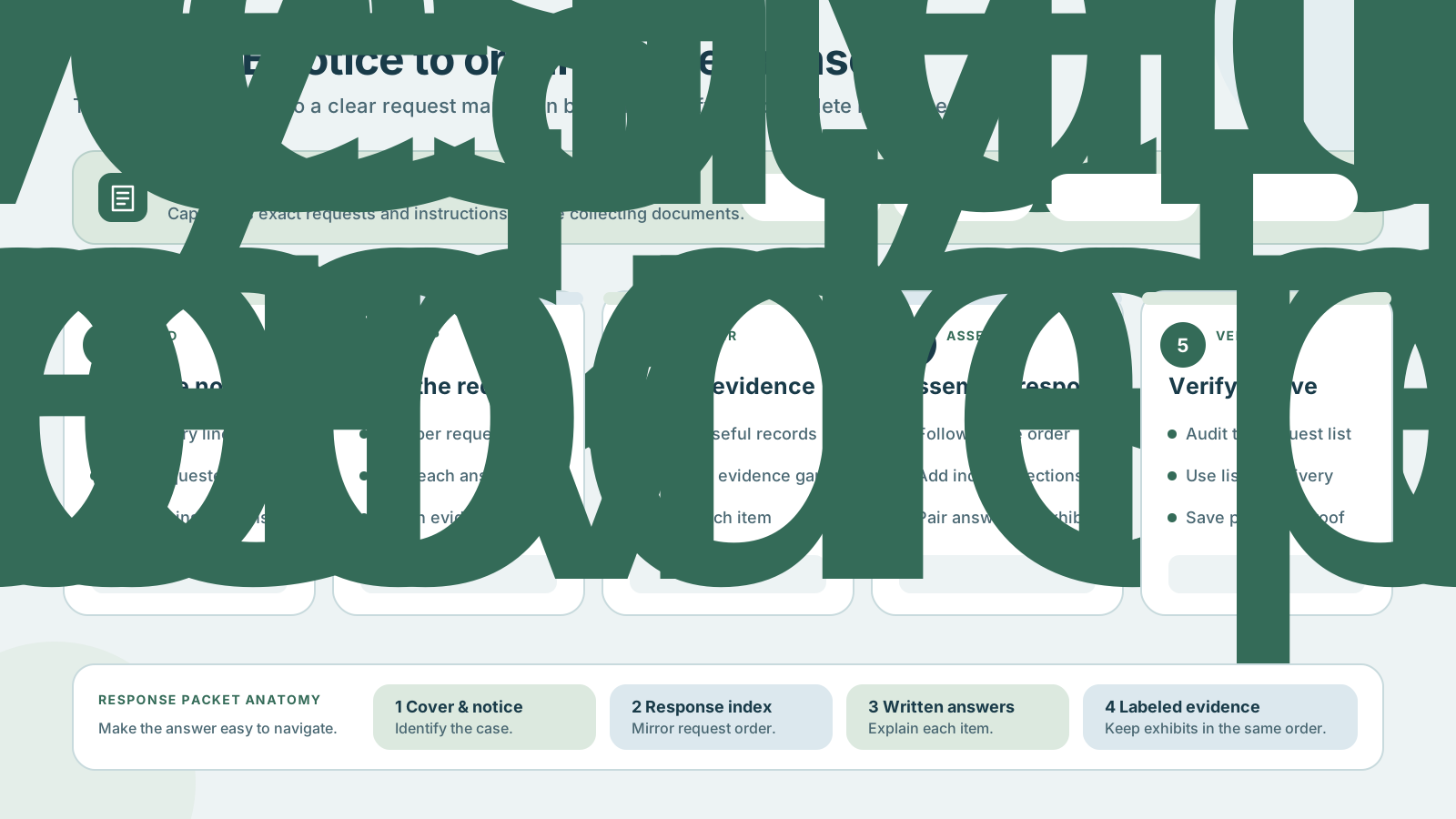
Treat the notice as a case-specific assignment: identify every request, match it to evidence, assemble one response, and follow the stated submission instructions.
What does a Request for Evidence mean?
USCIS decides a benefit request from the record before it. An RFE identifies evidence the officer believes is needed to continue that decision.
An RFE may concern:
- required initial evidence that was not included or could not be verified;
- a document that is incomplete, illegible, expired, inconsistent, or not issued in the required form;
- a question about whether the applicant or petitioner meets a legal requirement;
- financial sponsorship evidence;
- the qualifying family relationship or bona fide marriage;
- an applicant’s entry, status, identity, or immigration history; or
- another case-specific eligibility issue.
An RFE differs from a Notice of Intent to Deny (NOID), which generally identifies intended denial grounds and permits a response. Confirm the name, form, receipt number, evidence requested, deadline, submission method, and stated consequences. The final page may contain the most important instructions.
Read the complete RFE before collecting documents
Do not begin by searching for a sample response online. Begin with the notice USCIS issued in the actual case.
Check the name, receipt number, form, A-Number if listed, notice date, deadline, and page count. Mark every sentence asking the recipient to submit, explain, clarify, or establish something. Calendar internal dates for records, translation, review, assembly, and delivery. Scan the complete notice, retain the original and envelope, and use any response sheet or barcode as directed.
If USCIS online status shows that a notice was issued but it was not received, use the agency’s current non-delivery inquiry process rather than guessing what the notice requested.
Turn each request into a response plan
Create a response matrix before drafting a cover letter or combining exhibits.
| RFE request | What USCIS appears to question | Planned response | Source and owner | Status |
|---|---|---|---|---|
| Item 1 | Required record is missing | Official record plus translation | Applicant | Requested |
| Item 2 | Dates appear inconsistent | Correct record and concise factual explanation | Both spouses | Drafting |
| Item 3 | Financial evidence is incomplete | Current evidence required by the I-864 instructions | Petitioner | Reviewing |
For every item, decide whether the response will include:
- the exact evidence requested;
- permitted alternative or secondary evidence because the primary record is unavailable;
- a factual explanation supported by records; or
- a legal analysis that should be prepared or reviewed by qualified counsel.
The matrix reveals gaps and prevents a large response from overlooking a smaller request. Follow the RFE’s order whenever practical.
Choose evidence that answers the actual question
More pages do not automatically create a stronger response. The evidence should be relevant, authentic, readable, and tied to the deficiency USCIS identified.
If USCIS requests a specific document, provide it in the required form with every page, translation, certification, and issuing-authority feature described. If it cannot be obtained, review whether the rules allow proof of unavailability, secondary evidence, or affidavits; do not silently substitute another record.
Respond to the specific relationship concern rather than sending a random photo album. Depending on the request and the couple’s real circumstances, relevant evidence may cover shared residence, finances, insurance, taxes, travel, communication, family responsibilities, and the development of the relationship over time.
Explain genuine circumstances that affect the record—such as living apart for work, military service, school, caregiving, or immigration restrictions—without creating or altering evidence.
Return to the current Form I-864 instructions and the exact language of the RFE. Identify whose income, household-member income, assets, or joint sponsorship is being relied upon and submit the corresponding evidence required for that approach. Do not assume that sending additional tax pages resolves a different sponsorship problem.
Determine which answer is accurate, why the records differ, and whether an official correction or supporting record exists. A concise declaration can provide context, but it does not erase a material discrepancy or replace a required document.
Never backdate, alter, or manufacture a record. If the requested evidence exposes possible fraud, misrepresentation, inadmissibility, criminal history, or another serious legal issue, obtain individualized legal advice before responding.
Write explanations that help USCIS verify the evidence
A cover letter organizes the response; it is not evidence by itself. State facts directly, identify who has personal knowledge, present events chronologically, and cite supporting exhibits. Explain unavailable records with proof. Legal interpretations, waivers, exceptions, or disputed findings may require qualified legal review.
Assemble and submit the RFE response
Follow the submission instructions in the notice even if a different method was used for the original case.
A clear response may use this order:
- the RFE response page, original notice, or barcode sheet as directed;
- a short cover letter with the receipt number and an exhibit index;
- a section for each numbered request;
- the responsive evidence and any required translation or certification; and
- any signed declarations or legal brief needed for that section.
Before sending, confirm every request is answered; names, dates, and explanations agree with the original filing or clearly document a correction; every page and translation is legible; and the response is timely and traceable. USCIS generally treats a partial response as a request for a decision on the existing record, so submit the requested material together. Save the final response and delivery or upload confirmation.
What happens after USCIS receives the response?
USCIS places the timely response into the case record and continues adjudication. The agency may:
- approve the application or petition;
- schedule an interview or another appointment;
- continue background or eligibility review;
- issue another notice where permitted and necessary; or
- deny the benefit request based on the record and applicable law.
There is no universal decision date after a response. Track delivery, monitor the USCIS account or Case Status Online, and keep the notice, response, and proof together. Do not submit unrelated evidence merely because the online status has not changed.
When an RFE deserves legal review
Some RFEs reveal a legal issue that formatting cannot solve. Consider prompt review by a qualified immigration attorney if the RFE involves:
- possible fraud, willful misrepresentation, or false documents;
- arrests, charges, convictions, or other criminal history;
- an entry without inspection, unlawful presence, or a possible adjustment bar;
- prior removal, deportation, voluntary departure, or immigration-court proceedings;
- a prior denial or inconsistent government filing;
- the legal validity of a marriage or termination of a prior marriage;
- a complex Affidavit of Support issue;
- missing evidence that the notice treats as essential;
- a deadline problem or uncertainty about the eligibility issue.
Bring counsel the original filing, complete RFE, evidence, and an accurate timeline.
Request for Evidence FAQs
Is an RFE the same as a denial?
No. An RFE asks for additional evidence before USCIS makes the decision, but approval is not guaranteed after a response.
Can the response deadline be extended?
Do not rely on an extension. USCIS sets the response period in the notice, and additional time generally is not granted under the RFE rules. Plan around the exact stated deadline.
Can some evidence be sent now and the rest later?
That is risky. USCIS generally expects the requested evidence to be submitted together, and a partial response may be treated as a request for a decision on the record.
What if USCIS asks for something that does not exist?
Do not ignore the request. Investigate whether the primary record is officially unavailable and whether the applicable rules permit secondary evidence or a documented explanation. Complex situations may require legal analysis.
How can the sender prove the response was submitted?
Keep a complete final copy and the available mailing, courier, or online submission confirmation showing when and where the response was delivered or uploaded.
The bottom line
An RFE is a structured opportunity to complete the record before USCIS decides the case.
The response should do five things well:
- identify every request in the notice;
- provide evidence that answers the precise issue;
- explain genuine gaps or inconsistencies clearly;
- follow the required submission method and deadline; and
- preserve a complete, traceable copy.
Do not let urgency turn the response into an unorganized document dump. Treat the notice as a checklist, connect every exhibit to a request, and obtain legal help when the issue is eligibility rather than paperwork.
Organize the next step
Begin with Getting Your Marriage Green Card Documents Together or review Your Marriage Green Card Journey. Dokumen can help organize the notice, tasks, and files; it does not replace legal advice.
Official sources
- USCIS Policy Manual — Volume 1, Part E, Chapter 6: Evidence
- USCIS Policy Alert — Requests for Evidence and Notices of Intent to Deny
- USCIS — Non-Delivery of Notice
- USCIS — Case Status Online
- USCIS — Form I-130, Petition for Alien Relative
- USCIS — Form I-864, Affidavit of Support
Last reviewed: October 12, 2026
Legal information only. Dokumen is not a law firm and does not provide legal advice. Immigration rules depend on individual circumstances. When eligibility, deadlines, inadmissibility, or prior immigration history is uncertain, consider speaking with a qualified immigration attorney.