Based on official U.S. Citizenship and Immigration Services (USCIS) and U.S. Department of State guidance. Always use the current form edition and instructions for the filing path that applies to the case.
A marriage green card case is not built around one universal application. It usually combines a family petition, a permanent-residence application, financial sponsorship evidence, civil records, and—depending on the path—medical, employment, or travel forms.
The central forms are usually Form I-130 for the qualifying spousal relationship and either Form I-485 for Adjustment of Status in the United States or Form DS-260 for immigrant-visa processing abroad. Other forms support a specific part of the case; they do not replace the main petition or application.
Before completing any form, identify the correct filing path. If that question is still open, start with Adjustment of Status vs. Consular Processing.
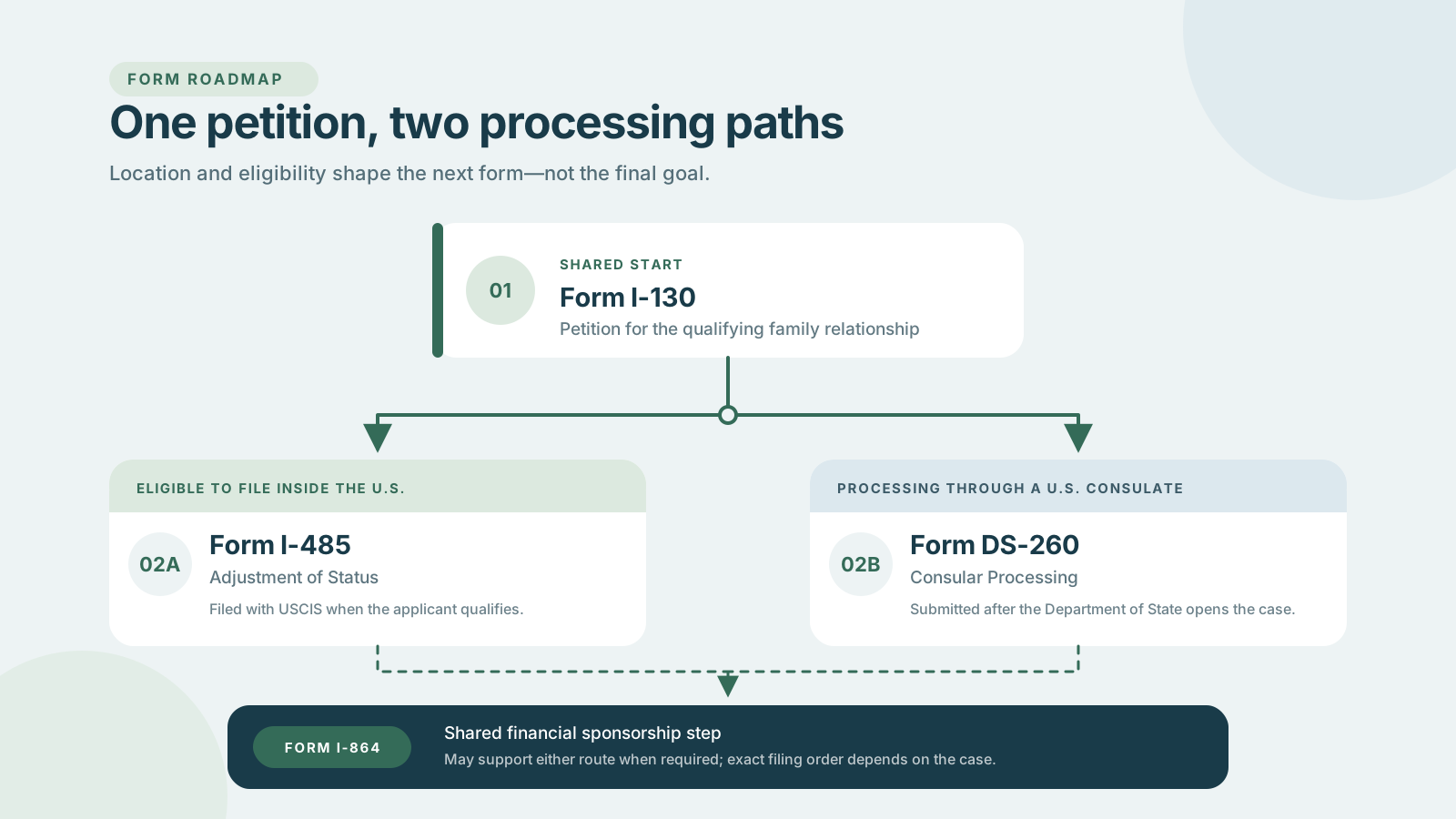
The relationship petition establishes the family connection; the permanent-residence application depends on the filing path; supporting forms address separate requirements.
What forms are commonly used in a marriage green card case?
The exact form set depends on where the immigrant spouse is applying, the petitioner’s status, visa availability, and the applicant’s immigration history.
| Form | Primary purpose | Commonly associated path |
|---|---|---|
| Form I-130, Petition for Alien Relative | Asks USCIS to recognize the qualifying family relationship | Adjustment of Status and Consular Processing |
| Form I-130A, Supplemental Information for Spouse Beneficiary | Provides additional biographical and address information about a spouse beneficiary | Filed with a spousal Form I-130 |
| Form I-485, Application to Register Permanent Residence or Adjust Status | Asks USCIS to grant permanent residence to an eligible applicant in the United States | Adjustment of Status |
| Form DS-260, Immigrant Visa and Alien Registration Application | Applies electronically for an immigrant visa | Consular Processing |
| Form I-864, Affidavit of Support | Documents the sponsor’s financial commitment and supporting financial information when required | Common in both paths |
| Form I-693, Report of Immigration Medical Examination and Vaccination Record | Records the immigration medical examination completed by a designated civil surgeon | Adjustment of Status |
| Form I-765, Application for Employment Authorization | Requests employment authorization when a qualifying basis exists | Optional in many pending Adjustment of Status cases |
| Form I-131, Application for Travel Documents, Parole Documents, and Arrival/Departure Records | Requests the applicable travel document or parole benefit | May be relevant during Adjustment of Status |
Who completes each marriage green card form?
The petitioner is the U.S. citizen or lawful permanent resident asking USCIS to recognize the spousal relationship. The petitioner signs Form I-130 and generally supplies proof of their status, the legal marriage, termination of prior marriages, and the bona fide relationship.
The beneficiary is the spouse for whom the petition is filed. In a spousal case, the beneficiary generally completes and signs Form I-130A as required by its instructions. If applying through Adjustment of Status, the beneficiary is also the Form I-485 applicant. If applying through Consular Processing, the beneficiary completes Form DS-260 as the immigrant-visa applicant.
The person signing Form I-864 is the sponsor. That is often the petitioner, even when a household member or joint sponsor also provides a separate financial sponsorship form. Each signer should understand that Form I-864 is a legally enforceable contract; it is not simply an income worksheet.
How do the forms work together?
Think of the forms as connected decisions rather than a stack of duplicate questionnaires.
- Form I-130 addresses the relationship. USCIS decides whether the petitioner has established a qualifying spousal relationship.
- Form I-485 or Form DS-260 addresses permanent residence. The government reviews the immigrant spouse’s eligibility and admissibility through the applicable path.
- Form I-864 addresses financial sponsorship. The sponsor provides the required contract and supporting financial evidence unless an exemption applies.
- Medical documentation addresses health-related requirements. The applicant completes the examination through the authorized medical professional for the chosen path.
- Optional benefit requests address a separate need. Filing Form I-485 does not itself authorize employment or international travel. Eligible applicants may file the appropriate request, but should not act as if it has been approved while it remains pending.
Some eligible spouses may file Forms I-130 and I-485 together. This is called concurrent filing. It is not available in every family category or circumstance, and it does not combine the forms into one decision. USCIS still adjudicates each request under its own requirements.
A practical form-by-form review
Review each form at three levels: the form itself, the evidence required by its current instructions, and its consistency with every other submission.
| Review question | What to verify |
|---|---|
| Identity | Legal names, other names used, birth date, country of birth, identifying numbers, and passport details are accurate and consistently formatted |
| Address history | Dates do not contain unexplained gaps or conflicts, and current mailing and physical addresses are distinguished correctly |
| Marriage history | The marriage date and location match the certificate, and every prior marriage is listed with accurate termination information |
| Immigration history | Entries, departures, status, prior petitions, applications, denials, and proceedings are answered completely where requested |
| Employment history | Employer names, locations, job dates, and current income information agree with supporting records where relevant |
| Yes-or-no questions | Every question is answered after reading its full wording, including definitions and time periods in the instructions |
| Evidence | Each required item is included, legible, and connected to the correct form; foreign-language documents have the required translation |
| Signatures and filing details | Every required signature is present and the current edition, fee, filing method, and destination are confirmed immediately before filing |
How to review the forms before filing
Use a final review that separates eligibility, accuracy, and assembly.
Confirm eligibility first
A perfectly organized form does not solve an eligibility problem. Confirm that the petitioner may file for the spouse, that the chosen permanent-residence path is available, and that potential adjustment bars or grounds of inadmissibility have been considered. Entry without inspection, removal history, arrests, fraud or misrepresentation concerns, and unlawful presence can require individualized analysis.
Compare repeated answers side by side
Create a short fact sheet containing the couple’s names, birth information, marriage history, addresses, employment, and immigration events. Compare it against every draft. The fact sheet is a review tool—not a substitute for reading each question in context.
Read the current official instructions
USCIS can change form editions, filing locations, evidence requirements, and fees. The form page and instructions control over an old checklist, saved PDF, video, or prior filing. For DS-260 and NVC submissions, follow the instructions in the case account and those for the assigned embassy or consulate.
Marriage green card form FAQs
Is Form I-130 the green card application?
No. Form I-130 asks USCIS to recognize the qualifying family relationship. The immigrant spouse separately seeks permanent residence through Form I-485 or applies for an immigrant visa through Form DS-260, depending on the path.
Does every spouse file Form I-485?
No. Form I-485 is for an applicant seeking Adjustment of Status in the United States who is eligible to use that process. A spouse completing Consular Processing generally uses Form DS-260 instead.
Can Forms I-130 and I-485 always be filed together?
No. Concurrent filing depends on the immigrant category, visa availability, adjustment eligibility, and other case facts. It is often available to eligible immediate relatives of U.S. citizens, but being married or physically present in the United States is not enough by itself.
Is Form I-765 required for a marriage green card?
No. It is a separate request for employment authorization. Some eligible adjustment applicants file it while Form I-485 is pending. A pending or approved Form I-130 alone does not provide work authorization.
The bottom line
Marriage green card forms work as a connected record. Form I-130 establishes the claimed relationship; Form I-485 or DS-260 asks for permanent residence through the correct path; and the supporting forms address financial sponsorship, medical requirements, or separate interim benefits.
The strongest final review asks three questions:
- Is this the correct form set for the filing path?
- Is every answer complete, truthful, and consistent with the evidence?
- Were the current instructions, fees, signatures, and submission rules checked immediately before filing?
Plan the next step
If the filing path is not yet clear, compare Adjustment of Status and Consular Processing. For the broader relationship, evidence, and sponsorship framework, read What Is a Marriage-Based Green Card?.
When the form set is clear, use the Dokumen eligibility quiz to organize the starting facts and identify topics that may need closer review.
Official sources
- USCIS — Form I-130, Petition for Alien Relative
- USCIS — Form I-485, Application to Register Permanent Residence or Adjust Status
- USCIS — Form I-864, Affidavit of Support
- USCIS — Form I-693, Report of Immigration Medical Examination and Vaccination Record
- USCIS — Form I-765, Application for Employment Authorization
- USCIS — Form I-131, Application for Travel Documents, Parole Documents, and Arrival/Departure Records
- USCIS — Adjustment of Status
- U.S. Department of State — Immigrant Visa Process
Last reviewed: October 12, 2026
Legal information only. Dokumen is not a law firm and does not provide legal advice. Immigration rules and form requirements depend on individual circumstances and can change. Review the current instructions for every form and consider speaking with a qualified immigration attorney when a case involves legal uncertainty, prior immigration history, arrests, or possible inadmissibility.