Based on official U.S. Citizenship and Immigration Services (USCIS) guidance. This guide explains the structure of the process so you can identify the path and evidence that may apply to your case.
A marriage-based green card is U.S. lawful permanent resident status obtained through a qualifying marriage to a U.S. citizen or lawful permanent resident. It allows an eligible immigrant spouse to live and work permanently in the United States.
The short answer is that marriage creates a family relationship that may support a green card case, but getting married does not automatically grant immigration status or guarantee approval.
Marriage establishes the family relationship that can form the basis of an immigration case. The couple must still complete the appropriate immigration process and establish that the requirements for permanent residence are met.
That distinction is the best place to begin, because almost everything else in a marriage-based case follows from it.
How does the marriage-based green card process work?
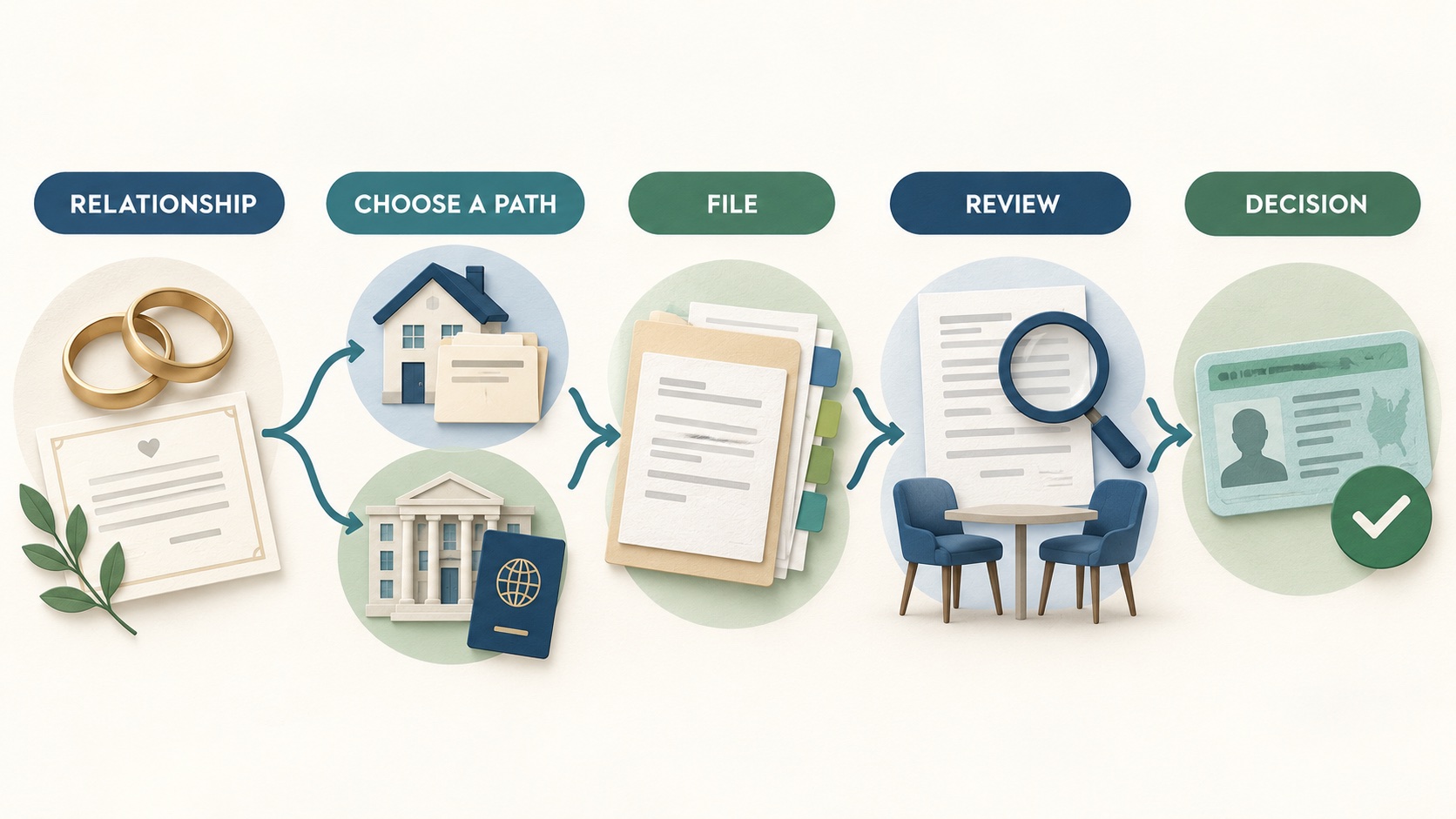
A typical case moves from establishing the relationship to choosing the correct path, filing the case, government review, and a decision.
| Question | What to know |
|---|---|
| Where does the case usually begin? | The U.S. citizen or permanent resident spouse generally files Form I-130, Petition for Alien Relative, to establish the qualifying marital relationship. |
| What are the two main routes? | An eligible spouse in the United States may use Adjustment of Status. A spouse completing the process abroad generally uses Consular Processing. |
| Do both routes lead to the same result? | Both routes can lead to lawful permanent residence, but they involve different agencies, forms, procedures, travel considerations, and eligibility questions. |
One of the first questions a couple should answer is not simply, “Which forms do we need?” It is:
Which immigration path actually applies to us?
What does a marriage-based green card actually give you?
“Green card” is the common name for evidence of lawful permanent resident status.
Once permanent residence is granted, the immigrant spouse generally has the right to:
- live permanently in the United States;
- work in the United States without needing a separate temporary employment status; and
- travel internationally, subject to the rules that apply to permanent residents.
Extended absences and certain other circumstances can affect permanent resident status, so international travel should still be planned carefully.
A green card can also become the foundation for eventual U.S. citizenship. Becoming a permanent resident does not make someone a U.S. citizen automatically; naturalization is a separate process with its own eligibility requirements.
The green card is evidence of the status. Lawful permanent residence is the underlying immigration status.
For most couples, however, “getting a green card” is a convenient way to describe becoming a permanent resident.
Marriage creates the relationship. It does not create permanent residence.
This is the most important concept in the entire process.
A valid marriage certificate can establish that two people are legally married. But USCIS still has separate questions to answer before the immigrant spouse can become a permanent resident.
At a high level, the government may need to determine:
- whether a legally valid qualifying marriage exists;
- whether the petitioner is a U.S. citizen or lawful permanent resident who can petition for the spouse;
- whether the marriage was entered into in good faith rather than to evade immigration laws;
- whether the immigrant spouse is eligible for the immigration process being used;
- whether any applicable grounds of inadmissibility or other immigration issues apply;
- whether the financial sponsorship requirements are satisfied; and
- whether the required forms and supporting evidence establish eligibility.
Think of a marriage-based case as two related questions:
- Is there a qualifying marital relationship?
- Is the immigrant spouse eligible to become a permanent resident through that relationship?
Form I-130 is primarily concerned with establishing the qualifying family relationship. Obtaining permanent residence requires more than approval of that petition alone.
Who can sponsor a spouse?
For the marriage-based process covered in this guide, the petitioning spouse is generally either a U.S. citizen or a lawful permanent resident.
A U.S. citizen
A spouse of a U.S. citizen is generally classified as an immediate relative for immigration purposes.
One important consequence is that immigrant visas for immediate relatives are not subject to the same numerical limits that apply to family-preference categories.
That does not mean the case is instant or automatically approvable. USCIS processing, eligibility review, document collection, the immigrant visa or adjustment process, and other requirements still take time.
It means that the spouse is not waiting for an immigrant visa number to become available under a numerically limited family-preference category.
A lawful permanent resident
A green card holder can also petition for a spouse.
The spouse generally falls within the family-preference system, so visa availability can become part of the process.
This distinction matters because two otherwise similar couples can face different filing options or timelines depending on whether the petitioning spouse is a U.S. citizen or a permanent resident.
The first major decision: Adjustment of Status or Consular Processing?
You will often see this simplified explanation:
- Inside the United States: Adjustment of Status
- Outside the United States: Consular Processing
That can be a useful starting point. It is not an eligibility rule.
Being physically present in the United States does not, by itself, establish that someone can adjust status. Adjustment eligibility can depend on the applicant’s immigration history, manner of entry, immigrant category, visa availability where applicable, adjustment bars, grounds of inadmissibility, and other facts.
Adjustment of Status
Adjustment of Status is the process through which an eligible person already in the United States applies to become a lawful permanent resident without completing immigrant visa processing abroad.
The central application is generally Form I-485, Application to Register Permanent Residence or Adjust Status.
Depending on the case, a marriage-based adjustment package may involve several other forms and supporting documents. For example:
- the petitioning spouse may file Form I-130 to establish the marital relationship;
- financial sponsorship commonly involves Form I-864; and
- some applicants with a pending I-485 may separately apply for employment authorization or advance parole.
Those interim benefits should not be confused with the green card itself.
Consular Processing
Consular Processing is the route through which the immigrant spouse applies for an immigrant visa abroad.
The process generally begins with the family petition. After the appropriate petition stage—and once the case is ready to proceed—the case may move through the National Visa Center (NVC) before the immigrant visa interview at a U.S. embassy or consulate.
The applicant completes the immigrant visa process rather than filing Form I-485 with USCIS.
If the immigrant visa is issued and the spouse is admitted to the United States as a permanent resident, lawful permanent resident status begins through that admission. The physical green card is then produced through the applicable USCIS process.
Why choosing the correct path matters
Adjustment of Status and Consular Processing are not simply two websites where the same application is submitted.
The path can affect:
- which forms are filed;
- where the applicant completes the process;
- which government agencies handle different stages;
- whether visa availability matters;
- the ability to travel during a pending U.S. adjustment case;
- eligibility for interim work authorization in an adjustment case;
- the sequence in which documents and fees are submitted; and
- what happens at the final interview.
For that reason, couples should determine the appropriate path before building their filing package, not after.
What is Form I-130, and why does nearly every marriage case start there?
Form I-130 is called the Petition for Alien Relative.
In a marriage case, the petitioning spouse uses it to ask USCIS to recognize the qualifying relationship between the petitioner and the immigrant spouse. The foreign spouse generally also provides biographical information through Form I-130A, Supplemental Information for Spouse Beneficiary.
It is tempting to think of an approved I-130 as approval of the green card. It is not.
An approved I-130 generally establishes the qualifying relationship for immigration purposes. The immigrant spouse must still complete the appropriate process for permanent residence and establish eligibility for that benefit.
This distinction becomes especially important in consular cases, where approval of the I-130 can occur well before immigrant visa processing is complete.
What does “bona fide marriage” mean?
A marriage-based immigration case is based on a real marital relationship, not merely possession of a marriage certificate.
USCIS therefore looks for evidence that the couple entered the marriage in good faith rather than for the purpose of obtaining an immigration benefit.
That does not mean every legitimate couple needs the same documents. Real marriages look different.
One couple may own a home together. Another may rent. One may combine nearly every financial account. Another may keep substantial finances separate. Newly married couples may simply have less joint history than couples who have been together for years.
USCIS’s Form I-130 instructions identify examples of evidence that may establish a bona fide marriage, including documentation of joint property ownership, a joint lease or common residence, combined financial resources, birth certificates of children born to the couple, qualifying third-party affidavits, and other relevant evidence of an ongoing marital union.
The practical lesson is not “collect as many documents as possible.” It is:
Build a consistent record of the life you actually share.
A thick file of repetitive evidence is not automatically stronger than a smaller, well-organized set of documents covering different parts of a genuine shared life.
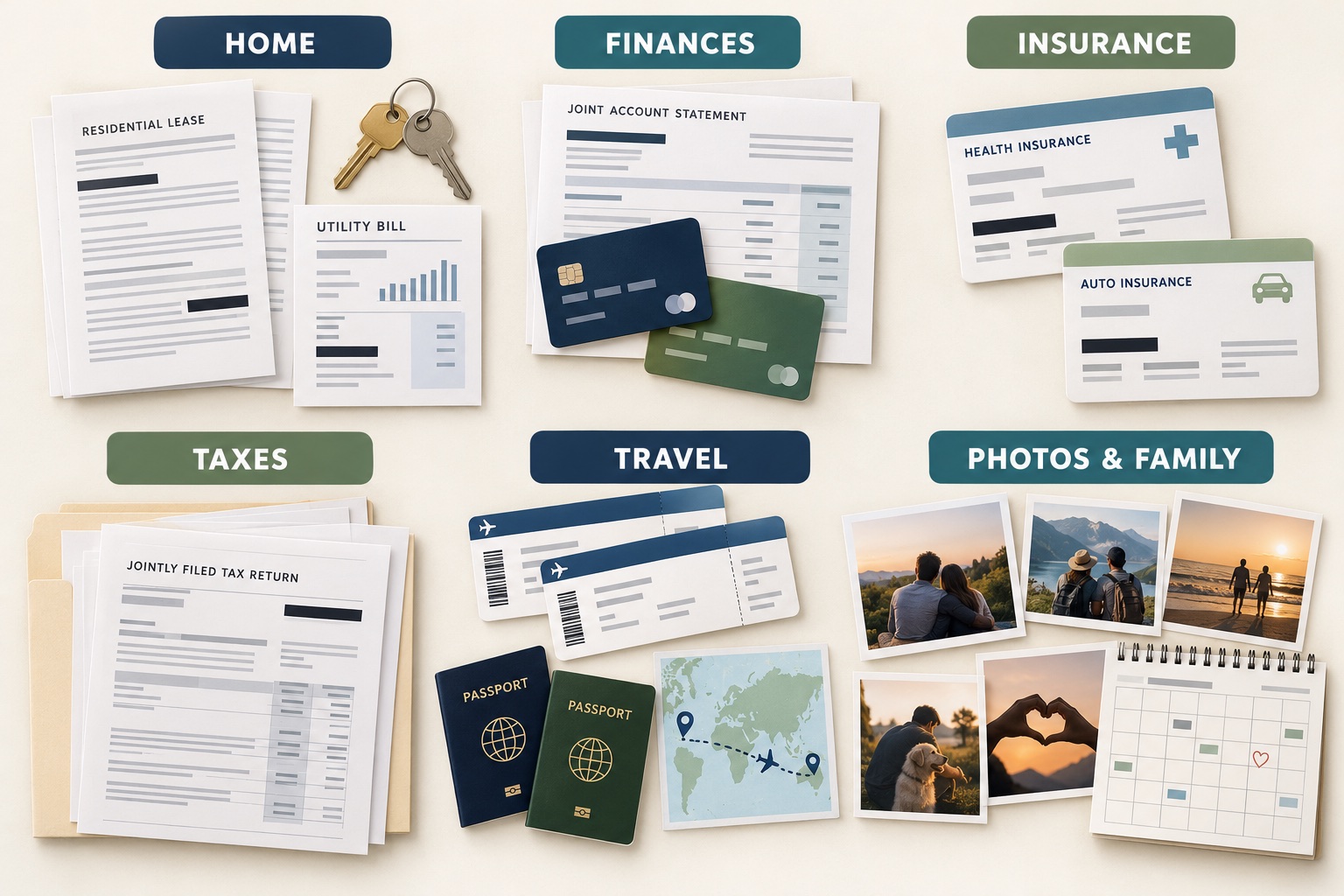
Evidence may come from the couple’s home, finances, insurance, taxes, travel, photographs, and family life. The strongest set is accurate, varied, and consistent with the couple’s real circumstances.
What evidence might a couple need?
The exact document list depends on the case and filing path, but marriage-based cases generally involve several categories of evidence.
Proof of the petitioner’s status
The petitioner may need evidence establishing U.S. citizenship or lawful permanent residence.
Proof of the legal marriage
This generally includes the marriage certificate and, where applicable, evidence showing that prior marriages were legally terminated.
Evidence of a bona fide marriage
Depending on the couple, useful records may include:
- joint leases or property records;
- joint checking, savings, or credit accounts;
- insurance policies showing one spouse as a beneficiary or covered family member;
- jointly filed tax records, where applicable;
- utility or other household records;
- travel records;
- photographs showing the relationship over time;
- records involving children or shared family responsibilities; and
- other documentation showing an ongoing marital union.
Civil and identity documents
Depending on the process, this may include birth certificates, passports, immigration records, photographs, and other civil documents.
Financial sponsorship evidence
The sponsor generally needs documentation supporting Form I-864 and the income or other financial resources being relied upon.
A complete checklist should be built around the specific case—not copied blindly from someone else’s filing.
Financial sponsorship is a separate part of the case
Marriage proves the family relationship. It does not satisfy the financial sponsorship requirement.
Most marriage-based immigrants must have a qualifying sponsor complete Form I-864, Affidavit of Support Under Section 213A of the INA.
For many sponsors, the key question is whether household income meets the applicable requirement. But falling short on income does not necessarily end the case.
Depending on the facts, USCIS’s I-864 instructions allow qualifying cases to rely on combinations that can include certain household-member income, qualifying continuing income of the intending immigrant, assets, or a joint sponsor.
The rules for counting income and assets are detailed enough that they deserve separate guides. The important point here is simple:
Do not wait until the end of the application to find out whether the financial sponsorship works. Evaluate it early.
- what counts as income or assets for Form I-864;
- what may help when the sponsor does not meet the income requirement; and
- how a joint sponsor works.
What happens after filing?
There is no single five-step sequence that accurately describes every marriage-based case. The process depends on the path.
A simplified Adjustment of Status case may involve
- The relationship petition and adjustment application
- Receipt notices
- Biometrics, if required
- USCIS review
- A possible Request for Evidence
- An interview, if USCIS requires one
- A decision
A simplified Consular Processing case may involve
- The petition stage
- NVC processing, when applicable
- Immigrant visa documentation
- A medical examination
- A consular interview
- A visa decision
- Admission to the United States as a permanent resident, if the visa is issued
Not every case receives exactly the same sequence of notices or interviews. And not every delay means something has gone wrong.
The better way to track a case is to understand which stage it is in and which agency currently controls that stage.
Does every couple have a marriage interview?
An interview is an important part of many marriage-based cases, but couples should not build their entire preparation strategy around memorizing answers to stereotypical questions.
The larger objective is consistency.
The forms, supporting evidence, immigration history, and answers given during the process should accurately describe the same underlying facts.
If an interview is scheduled, the couple should:
- review what was filed;
- bring the documents required by the appointment instructions; and
- be prepared to answer truthfully about the relationship and application.
An interview is not a trivia contest about your spouse. It is part of the government’s evaluation of eligibility.
What if USCIS wants more evidence?
Filing does not always lead directly to approval or denial.
USCIS may issue a Request for Evidence (RFE) when additional documentation or information is needed to determine eligibility.
An RFE does not automatically mean the case will be denied. It means USCIS is requesting specified information before making its decision.
The response deadline and requested evidence matter. Couples should read the notice carefully and respond to what USCIS actually asks for rather than sending a random volume of additional documents.
Good preparation before filing can reduce avoidable gaps, but no legitimate service should promise that a case will never receive an RFE.
How long does a marriage green card take?
There is no single reliable processing time for every marriage-based green card.
The timeline can depend on:
- whether the case uses adjustment or consular processing;
- whether the petitioner is a U.S. citizen or permanent resident;
- visa availability, where applicable;
- the USCIS office or service center handling relevant filings;
- whether additional evidence is requested;
- interview scheduling;
- NVC and consular processing in cases abroad; and
- the individual facts of the case.
For that reason, a static number such as “12 months” can become misleading quickly.
When planning around work, travel, housing, or major life events, use current government processing information for the specific stage of the case rather than assuming another couple’s timeline will apply to yours.
What if the marriage is less than two years old?
This is another area where timing is frequently misunderstood.
The relevant question is generally how long you have been married when permanent resident status is obtained.
If the marriage is less than two years old when the immigrant spouse obtains permanent resident status through the marriage, the spouse generally receives conditional permanent resident status for two years.
The couple generally later files Form I-751, Petition to Remove Conditions on Residence, during the 90-day period before the second anniversary of obtaining conditional status, unless another permitted filing basis or waiver applies.
If the marriage has already reached the two-year mark when permanent residence is obtained, the marriage-based two-year conditional residence rule generally does not apply.
| Common misunderstanding | General rule |
|---|---|
| “Married less than two years when you file means a two-year green card.” | The key date is generally when permanent residence is obtained—not when the application is filed. |
| “Conditional residence means USCIS trusts the marriage for only two years.” | Conditional residence is a statutory feature of qualifying marriage-based cases; it is not a judgment expressed by the card’s duration. |
Can the immigrant spouse work while the case is pending?
A pending marriage-based case does not, by itself, give every applicant unrestricted permission to work.
Some adjustment applicants may be eligible to apply for an Employment Authorization Document using Form I-765 while Form I-485 is pending. Other applicants may already have independent employment authorization through another status or category.
Consular-processing cases work differently because the immigrant spouse is generally completing the immigrant visa process abroad rather than waiting in the United States on a pending I-485.
Do not treat “married to a U.S. citizen” or “I-130 filed” as employment authorization. Work authorization is its own legal question.
Can the immigrant spouse travel while the case is pending?
Travel can also depend heavily on the immigration path and the applicant’s existing status and history.
For adjustment applicants, departing the United States while Form I-485 is pending can have significant consequences in some circumstances. Certain applicants may seek advance parole, but travel should not be treated casually simply because a travel document application has been filed.
Consular-processing applicants face a different set of travel considerations.
Because an incorrect assumption here can affect an active immigration case, applicants should understand the rules that apply to their particular status before leaving the United States.
Do you need an immigration lawyer?
Not every marriage-based case requires full attorney representation.
A straightforward case can still involve a substantial amount of paperwork, but paperwork volume and legal complexity are not the same thing.
Individualized legal advice can be especially important when a case involves:
- complicated immigration history;
- removal proceedings;
- possible inadmissibility;
- criminal history;
- fraud or misrepresentation concerns;
- prior immigration filings with significant issues; or
- uncertainty about whether the applicant can use the intended immigration path.
A useful question is:
Do we need help completing a process we understand, or do we need legal advice about whether and how we can proceed?
Those are different needs. Dokumen can help organize and guide an immigration filing process, but it should not replace individualized legal advice when the case requires legal judgment.
Marriage-based green card FAQs and common misconceptions
Does marriage automatically give a spouse legal immigration status?
It does not. Marriage can create the qualifying relationship for an immigration benefit; the immigration process still has to be completed.
Can every spouse inside the United States file Form I-485?
Not necessarily. Physical presence and eligibility to adjust status are different questions.
Does an approved Form I-130 mean the green card is approved?
No. I-130 approval generally establishes the qualifying relationship. Permanent residence requires the appropriate additional process.
How many photos are needed to prove a bona fide marriage?
There is no magic number. USCIS looks at relevant evidence of the bona fide marital relationship, and different categories of evidence can tell more of the story than repetitive documentation.
What happens if the sponsoring spouse’s income is too low?
The case may still have options. Depending on the facts, qualifying household income, assets, intending-immigrant income, or a joint sponsor may be relevant under the I-864 rules.
Why is a marriage-based green card sometimes valid for only two years?
The resident generally receives two-year conditional status when the qualifying marriage is less than two years old on the date permanent residence is obtained. Conditional residence is a statutory feature of those marriage-based cases, not an indication that the marriage was disbelieved.
Before you start filling out forms
You do not need to understand every immigration rule before starting. But you should know the answers to a few foundational questions.
- Who is the petitioner? Is the petitioner a U.S. citizen or lawful permanent resident?
- Where is the immigrant spouse completing the process? Inside the United States or abroad?
- Which path is legally available? Adjustment of Status, Consular Processing, or a situation that needs individual legal review?
- Is an immigrant visa immediately available? For spouses of permanent residents, visa availability may matter.
- Can the financial sponsorship requirement be satisfied? Income, qualifying additional income, assets, or joint sponsorship should be evaluated before the filing is assembled.
- Can you document the marriage clearly? You should be able to establish both the legal marriage and, where required, that it is bona fide.
- Is there anything in the immigrant spouse’s history that could change the analysis? Prior immigration violations, removal proceedings, criminal issues, previous applications, or other complications may require closer review.
If those seven questions are reasonably clear, the forms stop looking like a pile of unrelated government paperwork. They begin to make sense as parts of one case.
A better way to think about the entire process
You do not need to memorize every form number today. Start with the structure:
- Relationship — Can the petitioning spouse establish a qualifying marriage?
- Path — Will the immigrant spouse pursue Adjustment of Status or Consular Processing?
- Eligibility — Does the immigrant spouse satisfy the requirements for permanent residence through that path?
- Support — Can the applicable financial sponsorship requirements be met?
- Evidence — Do the documents establish the facts the government needs to decide?
- Review — Does USCIS—and, in a consular case, the applicable Department of State process—have what it needs to adjudicate the case?
- Permanent residence — If the requirements are satisfied and the case is approved, the immigrant spouse becomes a lawful permanent resident.
That is the marriage-based green card process in its simplest useful form.
Not one form. Not one interview. Not one marriage certificate.
A relationship, an immigration path, eligibility, evidence, and a government decision.
Where should you go from here?
Once you understand the overview, do not read every immigration guide at once. Read the one that answers the next question in your case.
- Unsure whether to file inside the United States or complete the process abroad? Read Adjustment of Status vs. Consular Processing.
- Ready to understand the relationship petition? Review Form I-130 and the evidence that establishes the qualifying relationship.
- Concerned about sponsorship? Review the income, asset, household-member, and joint-sponsor rules for Form I-864.
- Beginning document collection? Build a checklist around your filing path and circumstances.
- Preparing relationship evidence? Organize records that accurately show your shared life over time.
The goal is not to learn immigration law in one sitting. The goal is to understand the next correct step.
The bottom line
A marriage-based green card is a path to lawful permanent residence based on a qualifying marriage to a U.S. citizen or lawful permanent resident.
But the marriage itself is only the foundation.
The government still has to determine that the qualifying relationship exists, that the immigrant spouse is eligible for the process being used, that applicable financial sponsorship requirements are satisfied, and that the evidence supports approval.
For most couples, the process becomes much easier to understand once they stop thinking of it as a stack of forms.
Start with four things:
- Who is sponsoring?
- Where is the immigrant spouse?
- Which path applies?
- What must the couple prove?
Then build the application around those answers.
Not sure where your case fits?
Dokumen can help you identify the likely process before you start working through forms.
Answer a short set of questions about your marriage, immigration situation, and filing circumstances to see which path may apply and what you should review next.
Official sources
This guide is based primarily on current USCIS guidance and form instructions.
- USCIS — Form I-130, Petition for Alien Relative
- USCIS — Instructions for Form I-130
- USCIS — Form I-485, Application to Register Permanent Residence or Adjust Status
- USCIS — Form I-864, Affidavit of Support
- USCIS — Instructions for Form I-864
- USCIS — Conditional Permanent Residence
Last reviewed: October 12, 2026
Legal information only. Dokumen is not a law firm and does not provide legal advice. Immigration rules depend on individual circumstances. When a case involves legal uncertainty or significant immigration history, consider speaking with a qualified immigration attorney.