Based on official USCIS and U.S. Department of State guidance. The appointment notice and the instructions from the specific USCIS office, U.S. embassy, or U.S. consulate should guide the final preparation.
The best way to prepare for a marriage green card interview is to review the actual case that was submitted, identify what has changed, and organize the documents required by the appointment notice. Preparation should make the record easier to explain accurately; it should not create rehearsed or artificial answers.
An Adjustment of Status interview takes place with USCIS in the United States. A Consular Processing interview takes place at a U.S. embassy or consulate abroad. Their attendance and document rules are not identical.
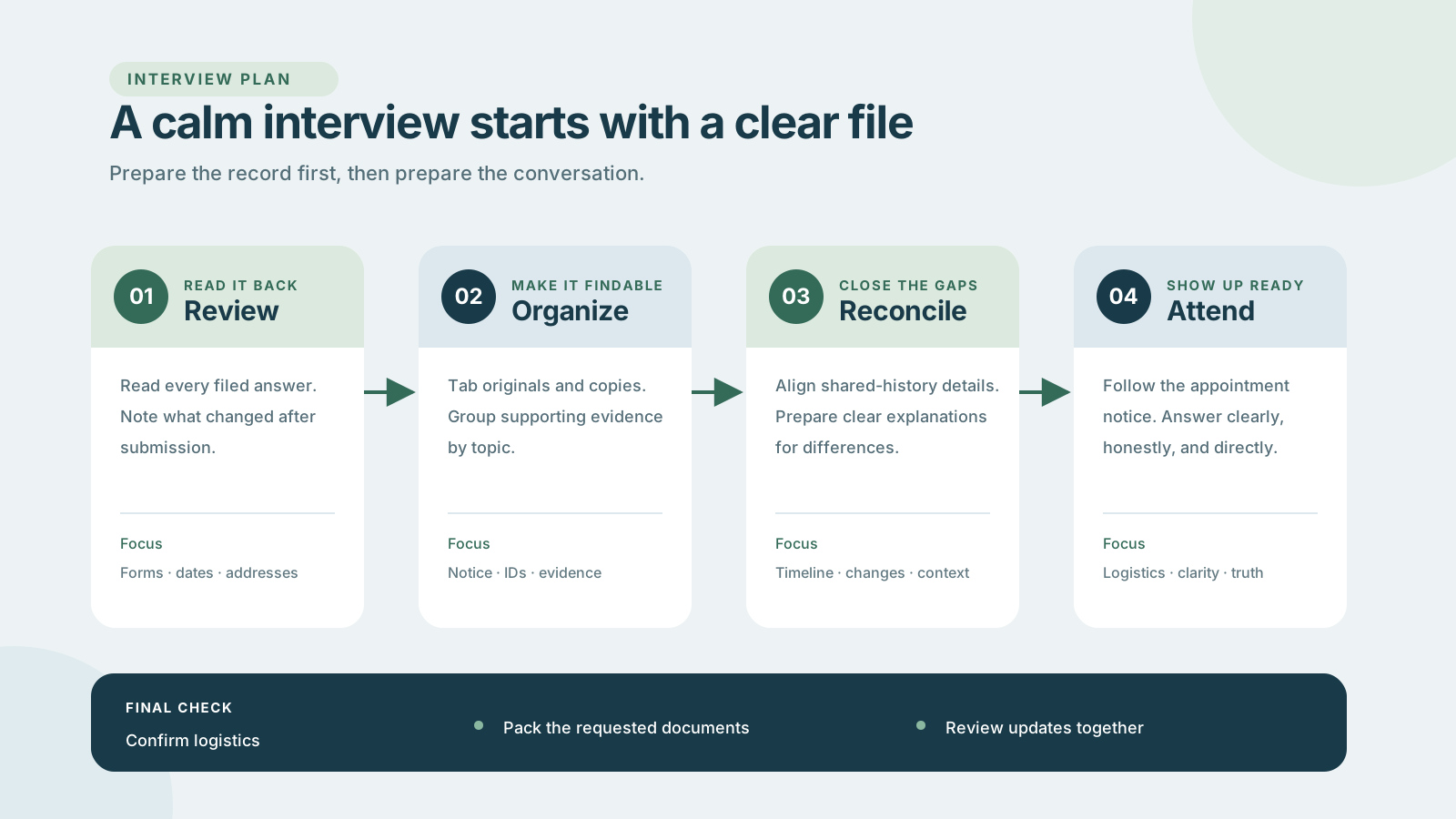
Good preparation aligns the filed forms, current facts, required records, and appointment instructions without scripting artificial answers.
What is the purpose of a marriage green card interview?
The interviewing officer uses the appointment to evaluate the pending request under the applicable immigration law. Depending on the case, the officer may verify identity, review eligibility and admissibility, confirm answers on the forms, ask about supporting records, and assess whether the marriage is bona fide rather than entered into primarily for an immigration benefit.
An interview is not limited to wedding details. The record can include:
- the petitioner’s status and the legal marriage;
- the history and development of the relationship;
- the immigrant spouse’s immigration history;
- financial sponsorship; and
- immigration or admissibility issues relevant to the application.
USCIS may waive an Adjustment of Status interview on a case-by-case basis. If USCIS schedules one, the notice tells the applicants where and when to appear and what to bring. A consular immigrant-visa applicant generally must attend the scheduled interview abroad; Department of State guidance says the sponsor or petitioner is not generally required to attend, although the assigned post’s instructions should always be checked.
Which type of interview will you attend?
| Question | USCIS Adjustment of Status interview | Consular immigrant-visa interview |
|---|---|---|
| Location | Usually a USCIS field office in the United States | The assigned U.S. embassy or consulate abroad |
| Main application under review | Form I-485, with the relationship petition and supporting record | Form DS-260 and the immigrant-visa case after petition and NVC processing |
| Who must attend | Follow the USCIS appointment notice; in a marriage case, USCIS may require both spouses | The immigrant-visa applicant must attend; follow post-specific instructions for all other attendees |
| Civil documents | Bring originals and other items requested by USCIS | Bring required original or certified civil documents submitted to NVC, plus items required by the post |
| Medical process | Completed by a USCIS-designated civil surgeon under Form I-693 instructions | Completed by an embassy-approved panel physician under post instructions |
| Decision maker | USCIS officer | Department of State consular officer |
How should a couple prepare?
Read the entire filed case
Review the final copy of every form and supporting document that was actually submitted. Pay particular attention to names, dates, addresses, employment, prior marriages, children, travel, immigration history, and yes-or-no eligibility questions.
If the couple discovers an error, do not agree to repeat it at the interview. Identify the correct fact, gather records that support it, and be prepared to explain the correction truthfully. A material error, prior false statement, arrest, removal history, or possible inadmissibility issue may require legal advice before the appointment.
Build one shared relationship timeline
Create a short timeline for review: when and how the couple met, important visits, engagement and marriage, periods living together or apart, moves, travel, and major family events. The timeline should reflect memory and records; it is not a script.
Update the case through the interview date
Gather focused evidence that covers the period after filing. Depending on the couple’s circumstances, that may include joint housing records, insurance, tax documents, financial accounts, travel records, correspondence, photographs, birth records for children, or other records showing a shared life.
Quality and context matter more than submitting every available page. Label the evidence by subject and date, and note material changes in address, employment, income, household size, marital circumstances, travel, arrests, or immigration status.
Marriage green card interview document checklist
Use this as an organizing framework, then replace it with the exact list in the appointment instructions.
| Folder | Examples to review or bring when required |
|---|---|
| Appointment and identity | Interview notice or appointment letter, government-issued identification, passport, required photographs, and DS-260 confirmation page for consular applicants |
| Civil records | Original or certified birth and marriage records, and proof that every prior marriage ended legally |
| Filed case copy | Final forms, submitted exhibits, receipt and approval notices, NVC correspondence, and any responses to government requests |
| Relationship evidence | A focused update of joint residence, finances, insurance, travel, family life, communications, or other relevant records |
| Financial sponsorship | Updated sponsor information or documents when requested or when a material financial or household change must be addressed |
| Medical documentation | The item required under the applicable civil-surgeon or panel-physician process; do not open a sealed medical envelope |
| Case-specific records | Certified court dispositions, immigration records, waivers, translations, or other documents requested for the individual case |
For a consular interview, bring the required original or certified-copy civil documents and complete the medical examination with an authorized panel physician as directed.
What should you expect at the interview?
Arrive according to the appointment instructions and allow time for security. Bring only permitted items. Procedures vary, but the officer may place the applicant under oath, verify identity, review forms, ask for corrections or updates, and examine supporting records.
Good interview habits are straightforward:
- Listen to the complete question. Ask for clarification if the wording is unclear.
- Answer the question truthfully and directly. Do not add a theory about what the officer wants to hear.
- Distinguish memory from certainty. Avoid guessing at dates or events.
- Correct important errors. Explain the accurate information and provide records where appropriate.
- Use documents deliberately. Know where key records are instead of handing over an unorganized bag or digital archive.
- Remain respectful. A follow-up question does not itself mean the case will be denied.
The officer may approve the case, continue review, or request additional evidence. Do not make irreversible plans based only on a favorable conversation; wait for the official decision or issued visa.
Changes or complications before the appointment
Do not wait until sitting in front of the officer to investigate a significant new issue.
Consider individualized legal advice if the case involves an arrest, separation or divorce, inaccurate prior statements, removal history, unauthorized documents, or another change that may affect eligibility.
If the appointment cannot be attended, follow the rescheduling instructions from the agency or post as soon as possible. Do not simply miss it. USCIS and Department of State cases have different procedures and consequences for failure to appear.
Marriage green card interview FAQs
Does every marriage green card case have an interview?
Not necessarily. USCIS can waive an Adjustment of Status interview on a case-by-case basis. Consular immigrant-visa processing generally includes an applicant interview at the assigned embassy or consulate.
What questions will the officer ask?
There is no single official script for every marriage case. Questions may address the forms, eligibility, immigration history, the legal marriage, the relationship, financial sponsorship, and supporting documents. The facts and unresolved issues in the file shape the interview.
What if an answer in the filed forms is wrong?
Prepare to correct it truthfully and bring supporting records when available. If the error concerns immigration history, criminal history, identity, marital status, or another fact that could affect eligibility, obtain qualified legal advice before the interview.
Does a good interview guarantee approval?
No. The agency must decide the case under all applicable requirements. An interview is one part of the record, and the officer may need additional review or evidence.
The bottom line
A well-prepared couple understands the filed case, can explain real events in ordinary language, and can quickly locate the documents required for the appointment. Preparation should reduce confusion without replacing honest memory with rehearsed answers.
Focus on four priorities:
- follow the exact appointment instructions;
- review the final filed forms and evidence;
- organize required originals and meaningful updates; and
- address serious corrections or new complications before the interview.
Prepare the next step
Review the overall process in What Is a Marriage-Based Green Card?, then confirm whether your appointment belongs to Adjustment of Status or Consular Processing.
Use the Dokumen eligibility quiz to organize the facts that may affect the path and identify questions to raise before the appointment.
Official sources
- USCIS Policy Manual — Adjustment of Status Interview Guidelines
- USCIS — Form I-485, Application to Register Permanent Residence or Adjust Status
- USCIS — Form I-693, Report of Immigration Medical Examination and Vaccination Record
- U.S. Department of State — Interview Preparation
- U.S. Department of State — Applicant Interview
- U.S. Department of State — Collect Civil Documents
Last reviewed: October 12, 2026
Legal information only. Dokumen is not a law firm and does not provide legal advice. Immigration rules and form requirements depend on individual circumstances and can change. Review the current instructions for every form and consider speaking with a qualified immigration attorney when a case involves legal uncertainty, prior immigration history, arrests, or possible inadmissibility.