Based on official USCIS and U.S. Department of State guidance. The exact evidence depends on the filing path and the couple’s facts. Always use the current form instructions and any case-specific government notice as the controlling checklist.
Marriage green card supporting documents should do more than fill a large folder. They should show, in a clear and verifiable way, who the parties are, why the requested immigration benefit is available, and how the evidence supports the facts stated in the forms.
A strong document system makes the application easier to assemble, review, and update. It also helps the couple find the exact record they need if USCIS, the National Visa Center, or a consular post asks a follow-up question.
The objective is not to submit every document the couple owns. It is to submit the records required by the current instructions and a well-chosen set of relevant supporting evidence.
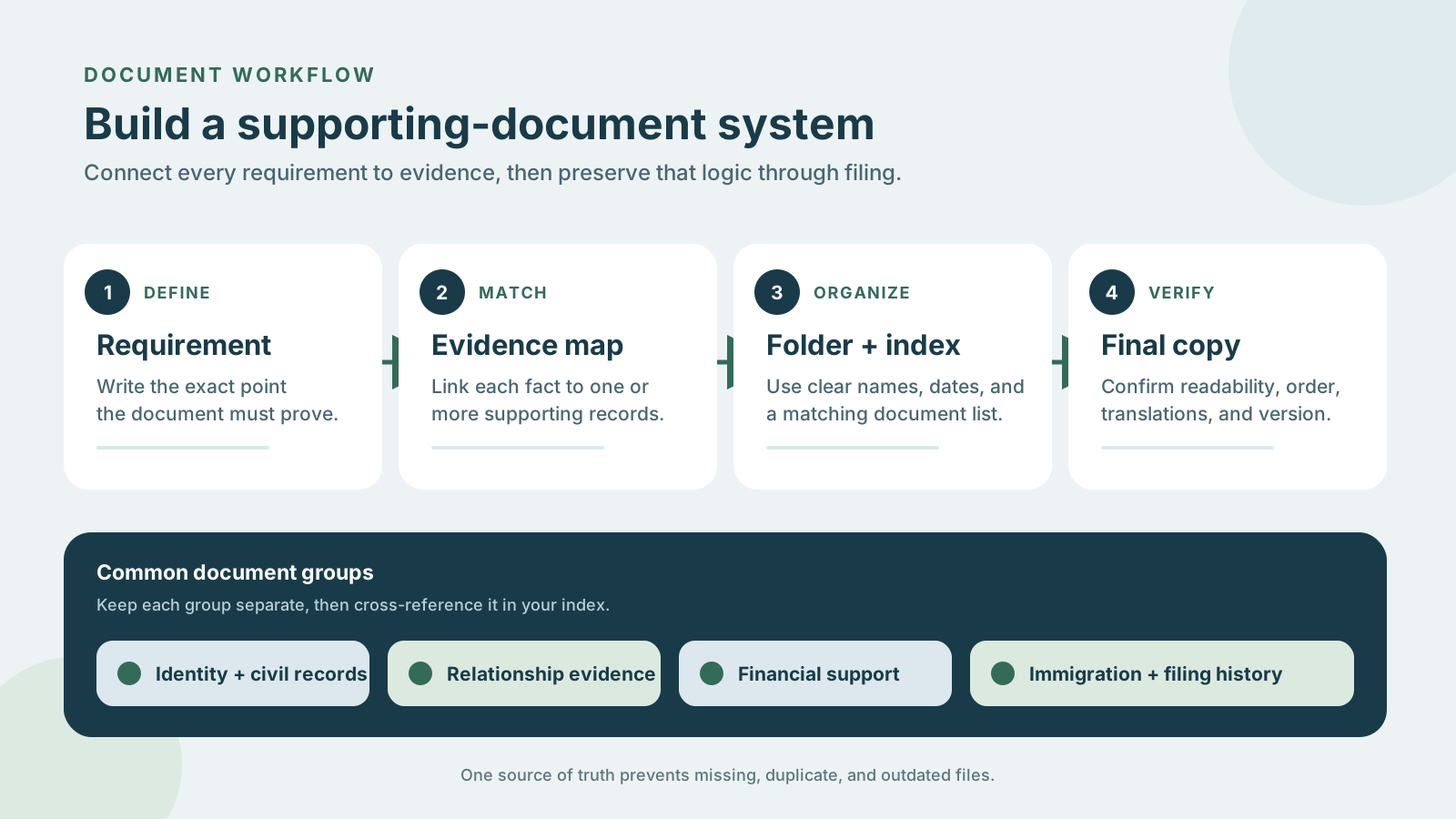
Keep one structure from collection through filing so reviewers can trace each requirement to the record that supports it.
What supporting documents does a marriage green card case need?
Most marriage-based cases draw from several evidence categories. The precise list changes according to whether the case uses Adjustment of Status or Consular Processing, the petitioner’s status, the applicant’s history, and the forms being filed.
| Evidence group | What it may establish | Common examples |
|---|---|---|
| Petitioner’s status | The petitioner may file for the spouse | U.S. passport, birth or naturalization record, or permanent resident card, as applicable |
| Legal relationship | A legally valid marriage and termination of prior marriages | Marriage certificate, divorce decrees, annulment orders, or death certificates |
| Identity and civil records | Names, birth facts, identity, and civil history | Passports, birth certificates, photographs, and country-specific civil records |
| Immigration history | Entry, status, and prior immigration activity | Form I-94, visas, prior notices, employment authorization documents, or removal records |
| Bona fide marriage | The marriage was entered in good faith | Shared residence, finances, insurance, taxes, travel, communications, photographs, and family records |
| Financial sponsorship | The applicable Form I-864 requirements are met | Tax transcripts, evidence of current income, qualifying assets, or joint-sponsor documents |
| Path-specific records | Requirements of adjustment or immigrant-visa processing | Medical documentation, NVC civil documents, police certificates where required, or interview records |
This table is an organizing framework, not a universal checklist. Each form’s webpage and instructions identify the required initial evidence for that filing.
Build an evidence map before building folders
An evidence map is a short working list that connects each fact or requirement to the record that supports it. Building one first prevents random document collection.
Start with five columns:
- Requirement or fact — for example, petitioner is a U.S. citizen.
- Form or instruction — where that fact is requested or required.
- Primary evidence — the strongest direct record available.
- Supporting evidence — additional records that provide context or continuity.
- Status — ready, needs translation, needs replacement, or question to resolve.
An evidence map can reveal gaps early. If a date appears differently on two records, or a required civil document is unavailable, the couple can address the issue before final assembly rather than during the last review.
Organize by purpose first and file type second. “Proof of shared residence” is more useful than a miscellaneous folder containing every lease, bill, and letter.
How to organize the document file
Use the same top-level structure for the working file, the review copy, and the final filing copy. A practical structure is:
- Filing instructions and checklist
- Forms and form supplements
- Petitioner’s status and identity
- Applicant’s identity and immigration history
- Marriage and prior-marriage records
- Bona fide marriage evidence
- Financial sponsorship evidence
- Medical or path-specific documents
- Translations and certifications
- Submission proof and government notices
Use descriptive file names
A consistent file name can include the category, date, and document description:
Shared-residence_2026-01_lease-renewal.pdf
Financial_2025_joint-tax-transcript.pdf
Travel_2024-08_family-trip-itinerary.pdf
Avoid names such as scan1.pdf, final-final.pdf, or IMG_0042.jpg. A reviewer should understand the file without opening it.
Preserve source quality
- Scan the complete document, including reverse sides that contain information.
- Keep text readable at normal magnification.
- Do not crop seals, signatures, page numbers, or identifying headers.
- Keep multi-page records in the correct order.
- Separate unrelated records rather than combining the entire evidence file into one unindexed scan.
- Retain the original electronic file when available.
If a filing is mailed, follow the current USCIS form instructions and filing guidance rather than relying on a packet arrangement from an old online example.
How to review documents for consistency
Government review often compares forms and evidence across the entire record. Before filing, check the fields that commonly repeat:
- full legal names and prior names;
- dates and places of birth;
- current and former addresses;
- dates of residence and employment;
- immigration entries, exits, and status history;
- marriage date and location;
- dates prior marriages ended;
- household members and children; and
- income figures and tax years.
A difference is not automatically a problem. People move, names change, and records can contain legitimate variations. The concern is leaving an unexplained inconsistency that makes the overall record harder to understand.
Translations
USCIS instructions generally require a complete English translation for a foreign-language document, together with the translator’s certification that the translation is complete and accurate and that the translator is competent to translate. Consular document rules can also include country- and post-specific requirements.
Do not translate only the portion that appears important. Preserve the relationship between the translation and the source document with clear labels and page order.
Copies and originals
Follow the instruction that applies to the stage. USCIS commonly accepts legible copies unless an original is specifically required, but it may later request an original. The Department of State generally requires immigrant-visa applicants to bring designated original or certified civil documents to the interview even when copies were uploaded earlier.
How to organize bona fide marriage evidence
Bona fide marriage evidence should show a real marital relationship over time. USCIS’s Form I-130 instructions identify examples such as joint property, a joint lease or common residence, combined financial resources, children’s birth certificates, qualifying affidavits, and other relevant evidence of an ongoing marital union.
Organize the evidence by theme and time period:
Shared home
Use leases, property records, mail, utilities, identification records, or other documents that accurately reflect where the couple lives. If the spouses temporarily live apart, do not manufacture a shared address. Explain the real circumstances and document how the relationship continues.
Shared finances and responsibilities
Relevant records can include joint accounts, insurance, tax records, beneficiary designations, household purchases, or evidence that the spouses share expenses and responsibilities. The goal is not a particular number of joint accounts; it is an accurate record of the couple’s financial life.
Relationship history and family life
Travel records, photographs, communications, family events, and records involving children can provide context. Select examples that cover the relationship’s timeline instead of submitting hundreds of repetitive screenshots or nearly identical photographs.
Third-party affidavits
When affidavits are used, follow the current I-130 instructions. A useful affidavit explains who the writer is, how the writer knows the couple, and the specific facts underlying that knowledge. General praise without firsthand detail usually adds little.
A genuine relationship does not have one required visual pattern. Organize the life the couple actually shares; do not imitate another couple’s evidence file.
What to leave out or handle carefully
More pages do not automatically create a stronger filing. Review carefully before including:
- duplicate copies that add no new information;
- illegible screenshots without dates or context;
- documents belonging to unrelated people;
- sensitive account information beyond what the filing needs;
- altered, reconstructed, or misleading records;
- originals when the instructions request copies; and
- commentary that conflicts with the forms or overstates what a document proves.
Never alter a document to make the facts look cleaner. If a record contains an error, keep the authentic record and determine the appropriate way to explain or correct it.
Supporting-document questions
Should the couple submit every available document?
No. Submit the required initial evidence and a relevant, varied set of supporting records. A focused file is easier to evaluate than a large collection of repetitive material.
How should missing documents be handled?
Check the controlling form instructions or, for consular processing, the Department of State’s country-specific civil-document guidance. The acceptable alternative may depend on the document, country, and reason it is unavailable.
Is a cover letter required?
Not for every filing. A concise cover letter or index can help identify forms and exhibits, but it does not replace a required form, signature, fee, or item of initial evidence.
Can new evidence be added after filing?
Sometimes, but the correct method depends on the stage and reason. Follow any USCIS or NVC upload instructions and respond directly to an RFE or interview notice. Do not send unsolicited material to an address unless the agency’s instructions permit it.
How long should filing copies be kept?
Keep a complete copy of what was submitted and every later notice for the life of the case. Important immigration and civil records may remain relevant well beyond the initial decision.
The bottom line
A well-organized marriage green card file answers three questions quickly:
- What requirement or fact does this document support?
- Does it match the information in the forms and the rest of the record?
- Can the couple find and explain it later?
Start with the official instructions, build an evidence map, use clear folders and file names, and preserve a complete filing copy. That system is more valuable than adding documents without a defined purpose.
Ready to build your document plan?
Review What Is a Marriage-Based Green Card? for the overall process, then use Getting Your Documents Together to turn the categories into a working checklist.
Official sources
- USCIS — Form I-130, Petition for Alien Relative
- USCIS — Instructions for Form I-130
- USCIS — Form I-485, Application to Register Permanent Residence or Adjust Status
- USCIS — Form I-864, Affidavit of Support
- U.S. Department of State — Collect Civil Documents
- U.S. Department of State — Applicant Interview
Last reviewed: October 12, 2026
Legal information only. Dokumen is not a law firm and does not provide legal advice. Immigration rules depend on individual circumstances. When a case involves legal uncertainty or significant immigration history, consider speaking with a qualified immigration attorney.